
The New Era of Search: Understanding Generative Engine Optimization
Quick answer: Generative engine optimization (GEO) is the practice of structuring content so AI answer engines such as ChatGPT, Google AI Overviews and Perplexity cite it. A Princeton study found adding quotations lifted AI visibility by up to 41% and statistics by 32%. Rocket Launch Media applies GEO for immigration law firms in English and Spanish.
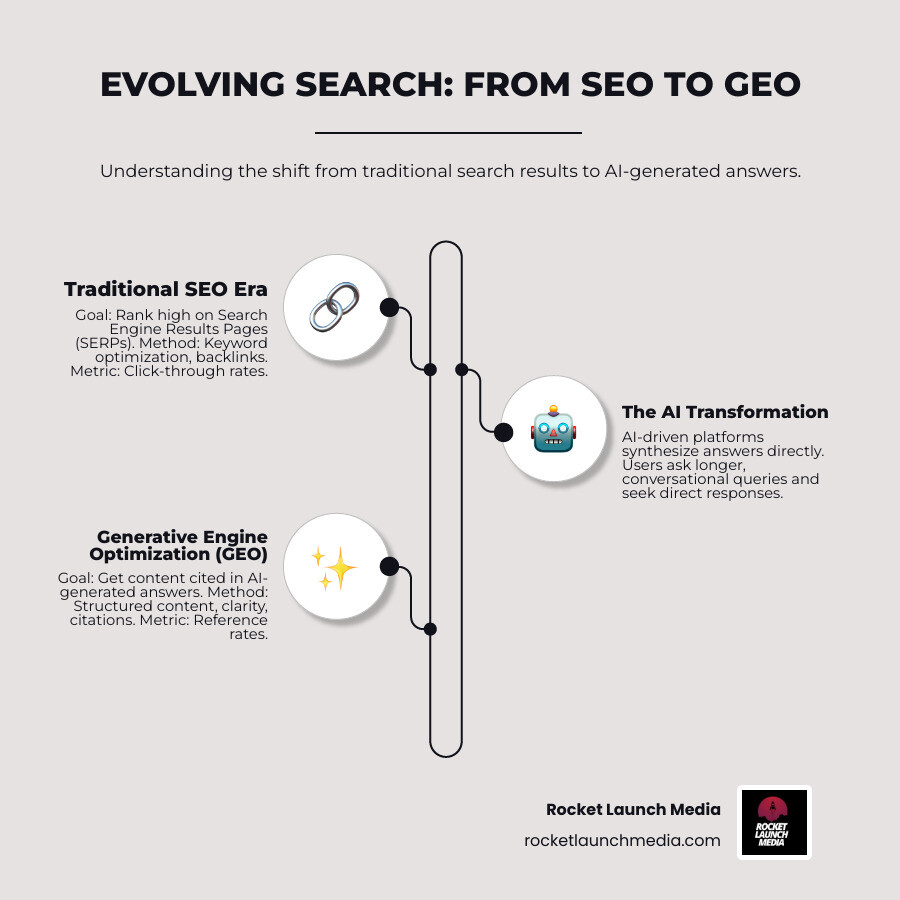
Generative engine optimization (GEO) is the practice of optimizing content to appear in AI-generated answers from platforms like ChatGPT, Google AI Overviews, and Perplexity, rather than just ranking in traditional search results.
Here’s what you need to know:
- What it is: GEO focuses on getting your content cited and referenced in AI-generated responses
- How it differs from SEO: Instead of ranking for keywords, you optimize for AI models to understand and use your content
- Key strategies: Use structured content, citations, statistics, quotations, and conversational language
- Success metric: Reference rates (how often AI cites your content) instead of click-through rates
- Impact: Princeton research shows GEO can boost visibility by up to 40% in AI responses
The digital marketing landscape is shifting fast. Traditional search engines are adding AI features, and AI-powered search platforms are gaining millions of users. 45% of U.S. consumers have now asked an AI tool for a local business recommendation, up from 6% a year earlier (BrightLocal, 2026), and ChatGPT cites about 15 sources in a typical answer (Semrush, 2026).
For law firms, this creates both challenges and opportunities. Prospective clients ask longer, more conversational questions (averaging 23 words instead of 4). They spend more time in search sessions (6 minutes on average) and get direct answers instead of clicking through multiple links.
The problem? If your content isn’t optimized for these AI systems, you risk becoming invisible to your target audience. The good news? The core principles that make content valuable to humans, clarity, expertise, and helpful information, also make it valuable to AI.
Now, let’s dive deeper into what generative engine optimization truly entails and how a law firm can use it.
What is Generative Engine Optimization (GEO)?
Remember when finding information online meant typing a few keywords into Google and clicking through a dozen blue links? Those days are quickly becoming history. Generative engine optimization represents a fundamental shift in how we think about content visibility in an AI-driven world.
Here’s what’s happening: instead of serving up lists of websites for you to explore, AI-powered platforms like ChatGPT, Google AI Overviews, and Perplexity AI are doing something entirely different. They’re reading your question, understanding what you really want to know, searching through countless sources, and then crafting a personalized, conversational answer just for you. No more hunting through multiple tabs or scanning through irrelevant content.
This is where Large Language Models (LLMs) come into play. These sophisticated AI systems don’t just match keywords like traditional search engines. They actually comprehend the meaning behind your user queries and generate synthesized answers that feel like they’re coming from a knowledgeable friend rather than a computer.
But here’s the challenge for business owners and content creators: if these AI systems can’t find, understand, or trust your content, you essentially become invisible to your potential customers. It doesn’t matter how brilliant your insights are or how perfectly your content answers someone’s question – if the AI doesn’t recognize its value, it won’t get included in those synthesized answers.
That’s where generative engine optimization becomes crucial. Unlike traditional SEO, which focuses on climbing the rankings ladder, GEO is about making your content visibility shine in AI-generated responses. It’s about structuring your content so clearly and authoritatively that AI systems naturally want to reference and cite it when answering related questions.
Think of it this way: traditional search engines were librarians who handed you a list of books to check out. AI-driven search platforms are more like research assistants who read all those books for you and give you a thoughtful summary, complete with citations to the most helpful sources. Your goal isn’t just to be in the library anymore – it’s to be the source that research assistant trusts and quotes.
The beauty of this shift is that the same qualities that make content valuable to humans – clarity, expertise, and genuine helpfulness – are exactly what these AI systems are looking for too. When you optimize for generative engines, you’re really just becoming better at serving your audience in this new, more conversational digital landscape.
GEO for Law Firms: What Changes
Law firms are a special case for GEO. Legal questions are Your Money or Your Life topics, so AI systems are cautious about which sources they cite, and the Princeton GEO study found that Law and Government pages benefit more than most categories from adding statistics. Four research findings shape what a law firm should do.
Quotes, statistics and citations move the needle. The Princeton University study GEO: Generative Engine Optimization (Aggarwal et al., KDD 2024) tested nine tactics across about 10,000 queries. Adding quotations raised visibility in generative engine answers by up to 41%, adding statistics by 32%, and citing sources by 30%. Keyword stuffing did nothing.
Freshness and original data are rewarded. Kevin Indig’s 2026 Growth Memo analysis of more than 21,000 citations found content under three months old is about three times more likely to be cited by LLMs, and pages with primary research earn about 3.3 times more citations. A law firm’s own case numbers, intake data and fee ranges are primary research nobody else can publish.
Format matters. Semrush’s 2026 AI Visibility Index, built on 126 million U.S. prompts, found ChatGPT cites about 15 sources per answer and that listicles account for 21.9% of citations, with articles at 16.7%. Comparison pages, FAQ pages and clearly headed guides are cited far more often than brochure-style service pages.
The audience is already there. BrightLocal’s 2026 Local Consumer Review Survey of 1,002 U.S. adults found 45% have used AI for a local business recommendation, up from 6% the year before, and 64% of adults aged 30 to 44. Someone asking ChatGPT for an immigration lawyer in Houston is a real prospect, not a hypothetical.
The mechanics follow from how retrieval works. AI answer engines pull passages, not pages, so each section of a law firm page has to make sense on its own. Mike King of iPullRank, who coined the term relevance engineering, puts it this way:
A longer piece of text that covers multiple subjects typically has lower relevance than a shorter piece of text that covers a single subject.
Mike King, iPullRank
Each chunk must stand as a standalone signal so that when the agent tears the binding off so to speak, the individual page survives.
Mike King, iPullRank
For a law firm that translates into a short checklist: one idea per paragraph; headings written as the questions clients ask; a 40 to 60 word direct answer at the top of every practice-area page; the firm name, practice areas, bar admissions and office locations stated in plain text; dated statistics with named sources; a byline and a last-updated date; FAQ sections with matching FAQPage schema; and consistent facts across Google Business Profile, bar directories and legal directories. Because OpenAI’s crawlers read HTML only and do not run JavaScript (Writesonic, March 2026), all of that has to be in the page source, not injected by a script.
Rocket Launch Media applies this checklist for immigration law firms in English and Spanish. The service is described at GEO for immigration law firms, and you can test your own firm with our free AI search visibility check.
Core Principles and Strategies for Generative Engine Optimization (GEO SEO)
The digital marketing world is experiencing a seismic shift. At Rocket Launch Media, we spent years helping clients master traditional SEO and PPC. Now we are navigating this new frontier of generative engine optimization alongside the immigration law firms we work with.
Think of it this way: for years, we’ve been teaching websites to speak Google’s language. Now we need to teach them to speak AI’s language too. The good news? Many of the fundamentals remain the same – creating valuable, trustworthy content that genuinely helps people.
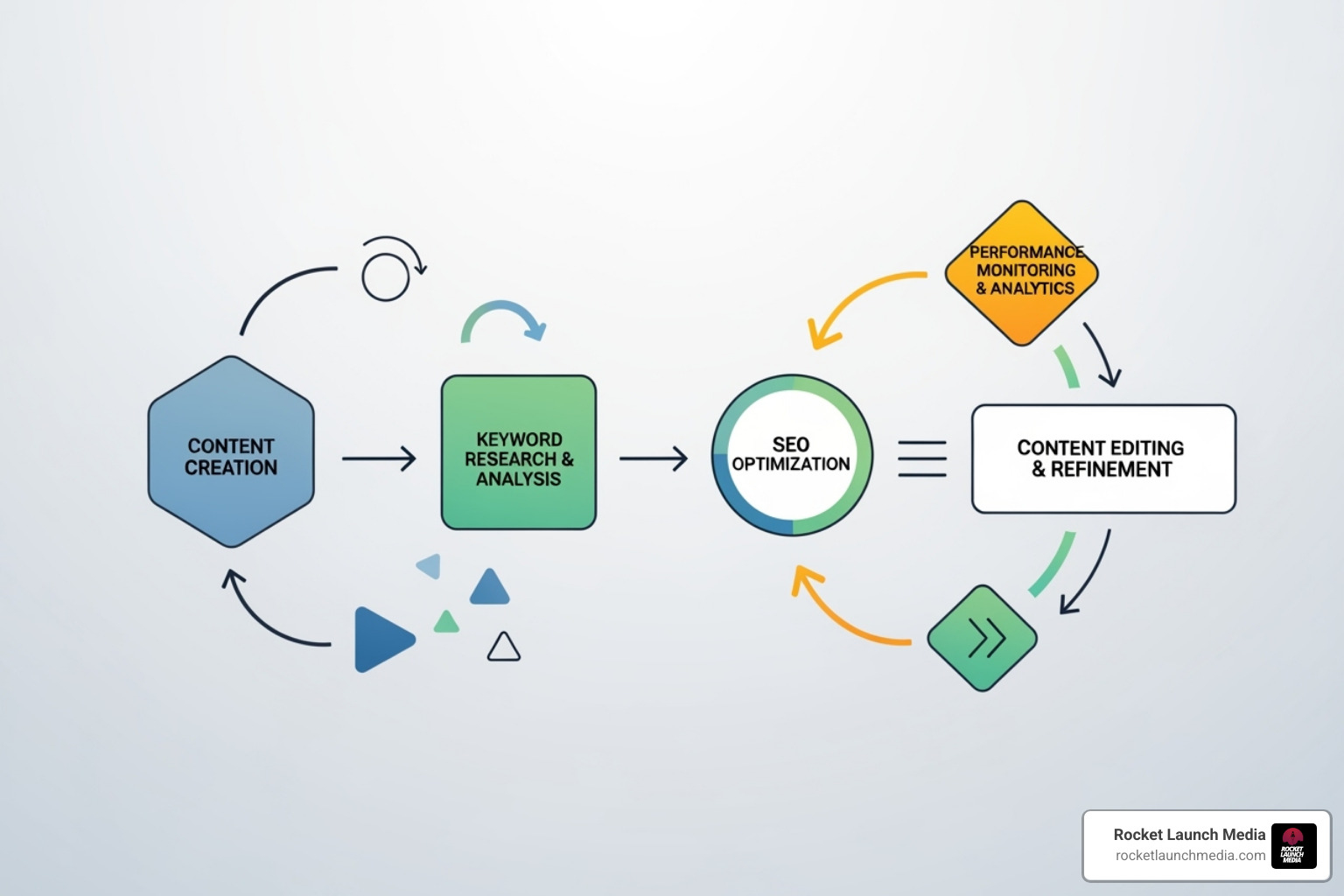
What’s changed is how we structure and present that content. AI systems are incredibly sophisticated readers, but they have preferences. They favor clear organization, authoritative sources, and factual accuracy over keyword density and backlink schemes.
Our approach focuses on making your firm’s narrative not just visible to human clients, but also understood and respected by AI models. This means optimizing for reference rates rather than just click-through rates, and ensuring your expertise shines through in every piece of content.
How GEO Differs from Traditional SEO
For decades, SEO was our North Star. We built entire strategies around climbing Google’s rankings, earning backlinks, and optimizing for specific keywords. It worked beautifully – and still does for traditional search.
But generative engine optimization plays by different rules entirely.
| Feature | Traditional SEO | Generative Engine Optimization (GEO) |
|---|---|---|
| Primary Goal | High page ranking on SERPs | Inclusion/citation in AI-generated answers |
| Primary Method | Keywords, backlinks, technical SEO | Content structure, clarity, factual accuracy |
| Monetization | Ad-driven (e.g., Google Ads) | Subscription plus ads (e.g., ChatGPT Plus, ChatGPT ads) |
| User Interaction | Click links to find answers | Receive direct answers from AI |
| Query Length | Shorter (avg. 4 words) | Longer (avg. 23 words) |
| Session Depth | Shorter | Deeper (avg. 6 minutes) |
The biggest difference? Traditional SEO aims to get you clicked on. GEO aims to get you cited as the expert source.
When someone searches “immigration lawyer near me” in Google, we want them to click through to your website. When they ask ChatGPT or Perplexity the same question, we want the AI to reference your firm directly in its answer – with a citation back to you as the trusted source.
This shift reflects how people are searching differently too. Queries are longer – averaging 23 words instead of 4. People are asking complete questions like “Can I get a green card if I overstayed my visa and my spouse is a citizen?” instead of just typing “green card lawyer.”
The business models behind these platforms also shape how they work. Traditional search engines make money when you click ads, so they need to send you elsewhere. AI platforms run largely on subscriptions, which means they can provide complete answers without needing you to leave. This makes getting cited even more valuable – it’s often the only way to get visibility.
Optimizing Content Structure and Format for AI Engines
AI models are like incredibly smart librarians – they love well-organized information they can quickly understand and reference. After analyzing millions of AI citations, researchers have identified the content formats that AI systems prefer most.
Listicles and comparison pages are gold. Semrush’s 2026 AI Visibility Index found listicles make up 21.9% of ChatGPT citations, the largest single format. There’s something about the clear, scannable structure that AI systems find easy to quote. When we create content like “7 Ways an Immigration Law Firm Can Improve Local SEO,” we’re speaking AI’s preferred language.
Clear headings and subheadings act like a roadmap for AI systems. They help the AI understand how your content is organized and what each section covers. We always use proper H2 and H3 tags to create a logical hierarchy.
Short paragraphs make content digestible for both AI and humans. Dense blocks of text are harder for AI models to parse and summarize effectively. We aim for paragraphs that make one clear point each.
Conversational language is crucial because AI systems use natural language processing to understand content. Writing like you’re explaining something to a friend helps AI better grasp and reproduce your ideas.
The original GEO research paper revealed something fascinating: simple tactics like keyword stuffing completely failed with AI systems. However, adding statistics and expert quotations boosted content visibility by over 40%. This is why we emphasize backing up every claim with data and including quotes from industry experts.
Schema markup provides structured data that gives AI systems clear context about your content. Google already uses schema for rich results, and it’s likely that AI overviews use it too. We implement schema for FAQs, legal services, attorneys, and other relevant content types.
Interestingly, Reddit emerged as one of the most-cited sources across millions of AI responses. This highlights how much AI values authentic, user-generated discussions over purely promotional content.
The Role of E-E-A-T, Keywords, and Citations in GEO
E-E-A-T – Experience, Expertise, Authoritativeness, and Trustworthiness – has become absolutely critical for generative engine optimization. While it was important for traditional SEO, it’s make-or-break for GEO because AI systems are incredibly cautious about citing unreliable sources, especially on legal topics.
Experience means demonstrating real-world knowledge. When we write about local SEO for immigration firms, we share specific numbers from our own client work, such as an immigration firm that took 143 calls from Google in a single month with no ad spend. AI systems can detect generic advice versus insights from actual experience.
Expertise requires having genuine knowledge in your field. For a law firm, this means attorney-reviewed content with a named byline, bar admissions and practice areas stated plainly.
Authoritativeness comes from being recognized as a leading voice. This builds over time through consistent, high-quality content and mentions from reputable sources, bar associations and legal directories.
Trustworthiness means providing accurate, verifiable information with transparent source citations. AI systems heavily favor content that backs up claims with credible references.
Keywords still matter, but their role has evolved dramatically. Instead of optimizing for short phrases, we focus on long-tail keywords and topic clusters that address complete user questions. People are asking AI systems full questions like “What are the most cost-effective Facebook ad strategies for an immigration law firm?”
Natural language processing is how AI understands content, so writing conversationally – the way people actually speak and ask questions – helps AI systems better interpret and use your content.
Reference rates have become the new gold standard metric. This measures how often your content gets cited as a source in AI-generated answers. It’s not just about traffic anymore – it’s about being the trusted expert that AI turns to.
The most effective E-E-A-T signals for GEO include having industry experts write or review content, citing authoritative sources throughout your articles, incorporating expert quotes from recognized voices, answering real user questions comprehensively, and keeping content updated with the latest information and data.
Tools and Platforms to Help with Your Generative Engine Optimization GEO SEO Strategy
The GEO landscape is evolving rapidly, and new tools are emerging to help us track and optimize our performance in AI-generated responses. At Rocket Launch Media, we’re constantly evaluating these platforms to find the ones that deliver real insights for our clients.
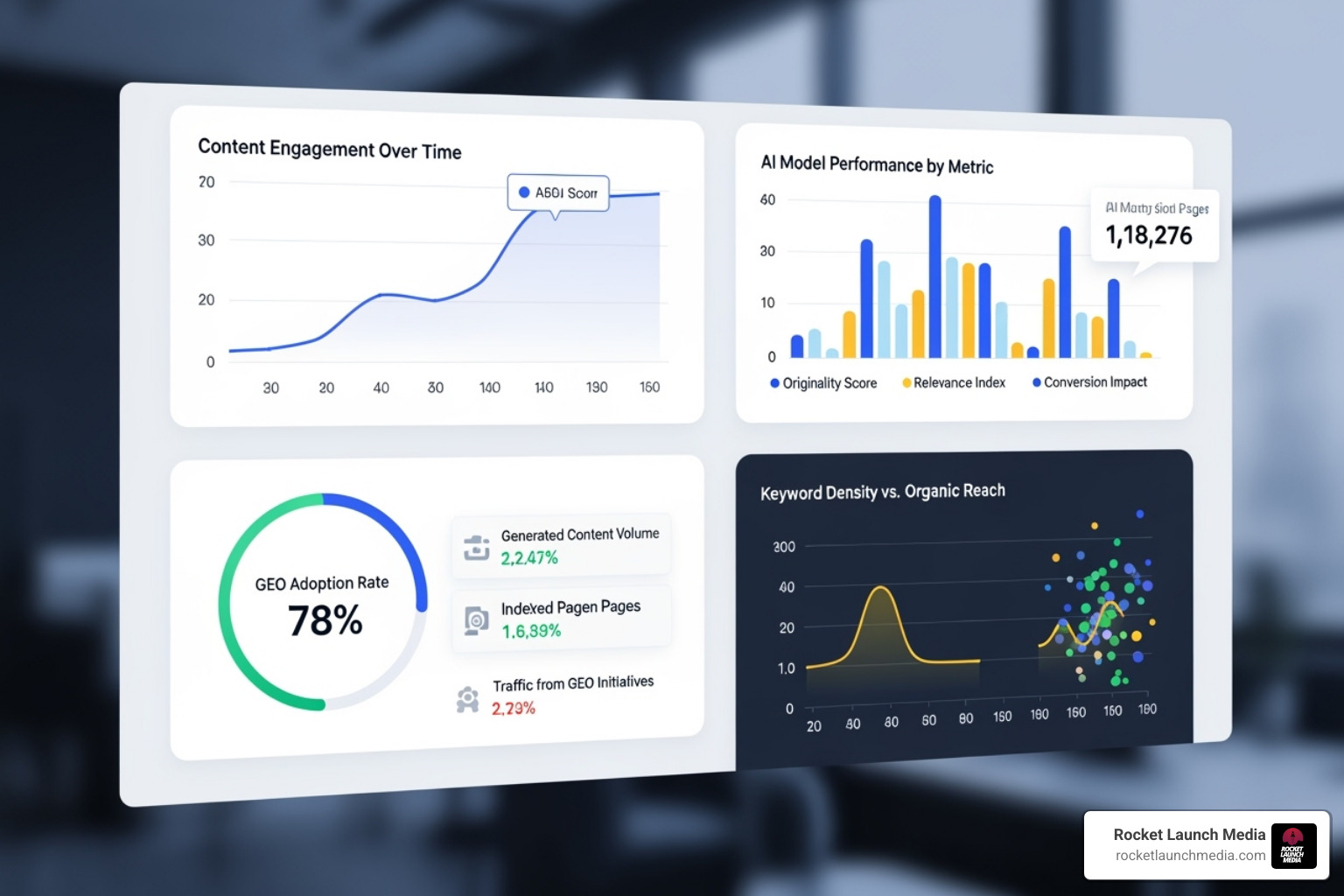
Brand monitoring has taken on new importance. We need to track not just where our clients are mentioned online, but how AI systems are representing their firms in generated responses. Platforms like Profound, Peec AI and Goodie run thousands of AI queries to see which brands get cited most often.
Sentiment analysis helps us understand the context of those mentions. Is the AI presenting your firm positively when it comes up in responses? Are there any misconceptions or negative associations we need to address?
Reference rate tracking measures how frequently your content gets used as a source. This is becoming as important as traditional ranking metrics because it shows whether AI systems view your content as trustworthy and authoritative.
Established SEO tools are adapting too. Ahrefs’ Brand Radar tracks brand mentions in Google’s AI Overviews and ChatGPT, while Semrush offers a dedicated AI toolkit for tracking brand perception across generative platforms. DataForSEO now reports AI search volume and LLM mention data by keyword.
HubSpot’s AI Search Grader provides a free benchmark of your current visibility in generative search engines. It shows your brand’s AI presence, identifies strengths and weaknesses, and measures your share of voice compared to competitors.
For hands-on testing, Perplexity AI does an excellent job of providing citations. You can use it to test whether your content gets picked up by searching for topics where your content should be authoritative. If Perplexity cites your content, there’s a good chance other AI systems will too.
These tools are becoming as essential as Google Analytics and Search Console were for traditional SEO. They help us understand not just how visible our clients are in AI responses, but how they’re being portrayed and whether that aligns with their goals.
The Future of Search and Measuring GEO Success
The world of digital marketing is changing fast, and generative engine optimization sits right at the center of this change. We’re witnessing something remarkable: search is becoming less about finding websites and more about getting direct answers from AI.

So how do we measure success in this new landscape? It’s not as straightforward as tracking keyword rankings anymore. Reference rates have become the gold standard – essentially, how often AI models cite your content when answering questions. This is your new “position one” in the AI world.
Brand perception tracking is equally crucial. Tools are emerging that analyze not just whether you’re mentioned, but how you’re portrayed. Are you being described accurately? Positively? The sentiment and context matter enormously because AI responses shape how thousands of potential clients perceive your firm.
Interestingly, early data suggests that conversions from AI-driven traffic can be higher than traditional search. Nate Tower noted that conversions from LLMs are higher by percentage, likely because users asking detailed questions to AI already have stronger intent.
We’re also seeing direct AI-driven referral traffic grow. While AI might summarize your content, compelling information still drives clicks when users want to dive deeper or book a consultation. Your share of voice in AI responses – how much of the AI’s industry-related answers come from your content – becomes a critical metric.
The implications for the future of digital marketing are massive. We’re moving toward AI search fragmentation where different platforms serve different needs. Instagram for visual discovery, Amazon for products, Siri for quick answers, and specialized AI chatbots for detailed conversations.
Voice search integration is accelerating this change. More users are speaking to AI rather than typing, which means your content needs to sound natural when read aloud. Multimedia content like videos and infographics are becoming more valuable as AI systems learn to interpret visual information, and Ahrefs’ 2026 study of 75,000 brands found YouTube mentions are the strongest single correlate of AI visibility.
At Rocket Launch Media, we’re already integrating these shifts into our strategies. We help immigration law firms prepare for a world where their content needs to work for both humans and AI systems. Our content marketing for immigration law firms service now focuses on creating material that gets cited, not just clicked.
Emerging Trends and Best Practices for Generative Engine Optimization GEO SEO
The generative engine optimization landscape is evolving rapidly, and smart firms are already adapting to these changes. Let’s explore what’s working now and what’s coming next.
Fragmented AI search is reshaping how we think about optimization. There’s no single “Google” of AI anymore. Platform-specific optimization means understanding that Instagram’s AI serves visual seekers, Amazon’s helps shoppers, and ChatGPT assists researchers. Each requires custom approaches, and Kevin Indig’s research found that 91% of citations appear in only one of ChatGPT, Perplexity or AI Overviews.
User context memory is game-changing. AI systems remember entire conversations, building on previous interactions. This rewards firms that provide consistently helpful, accurate information across all touchpoints. Your content becomes part of an ongoing relationship rather than isolated answers.
Voice search integration is accelerating faster than many predicted. When someone asks Siri a question while driving, they need concise, conversational answers. Your content should sound natural when spoken aloud – think about how an attorney would explain your topic to a client over coffee.
Multimedia content is gaining serious traction. AI can now interpret infographics, extract data from charts, and summarize video content. Chris Long from Go Fish Digital found that highly structured visual content gets pulled into AI responses more frequently. This makes sense – AI systems appreciate clear, organized information just like humans do.
Proactive content creation separates winners from followers. Instead of waiting to see what questions people ask, successful firms anticipate needs. They create comparative listicles, detailed guides, and FAQ-style content designed specifically for AI consumption.
Continuous monitoring isn’t optional anymore. The AI landscape shifts weekly, not yearly. Firms need real-time insights into how AI systems reference their content. Tools like HubSpot’s AI Search Grader and emerging platforms help track this, but the key is consistent attention.
Brand-driven strategies focus on narrative control. How do you ensure AI describes your firm accurately? By consistently producing expert-level content that aligns with your positioning. When AI encounters multiple high-quality sources from your firm, it builds a comprehensive, positive picture.
The significance of reference rates cannot be overstated. Research shows that adding citations, quotations, and statistics can boost visibility in AI responses by over 40%. This isn’t about keyword stuffing – it’s about becoming the authoritative source AI systems trust.
Some traditional marketers see this as threatening, but we view it as opportunity. Yes, click-through rates might decline for basic informational queries. But firms that master generative engine optimization become the trusted sources AI relies on. They get cited, referenced, and recommended.
At Rocket Launch Media, we help immigration law firms across the United States steer this transition. We integrate GEO principles into every content strategy, ensuring our clients remain visible whether prospects search traditionally or through AI. Our approach combines proven SEO fundamentals with cutting-edge AI optimization techniques.
The future belongs to firms that understand this shift. Your website needs to be more than a 24/7 sales tool – it needs to be an AI-friendly knowledge source that builds authority across every platform where your clients might search.
GEO by the Numbers
+41%
Lift in generative-engine visibility from adding quotations; statistics +32%, cited sources +30%.
Source: Aggarwal et al., Princeton University / KDD 2024
3x
Content under three months old is about three times more likely to be cited by LLMs; primary research earns 3.3x more citations.
Source: Kevin Indig, Growth Memo, 2026
17,940
Monthly ChatGPT prompts in the U.S. for immigration lawyer, the audience GEO puts an immigration firm in front of.
Source: DataForSEO via Rocket Launch Media, August 2026
Generative Engine Optimization FAQ
What is generative engine optimization?
Generative engine optimization (GEO) is the practice of structuring and sourcing web content so that AI answer engines such as ChatGPT, Google AI Overviews, Gemini and Perplexity understand it, trust it and cite it in their answers. It measures success by reference rate, meaning how often the AI names or links your page, rather than by keyword ranking or click-through rate.
How is GEO different from SEO?
SEO aims to rank a page in a list of results so a person clicks it. GEO aims to have an AI system quote or cite the page inside a synthesized answer. Both reward clear structure and authority, but GEO places far more weight on quotations, statistics, cited sources, freshness, single-idea passages and consistent entity facts, and far less on backlink volume and keyword density.
Does generative engine optimization work for law firms?
Yes. Law firm pages are Your Money or Your Life content, so AI engines are selective, but the Princeton GEO study found Law and Government pages gain more than most categories from added statistics. Rocket Launch Media has had its own law firm marketing articles cited by ChatGPT within days of publication by following the same method it applies for immigration law firm clients.
How long does GEO take to work?
Technical fixes such as schema, plain-text entity facts and crawler access take effect as soon as the page is recrawled, typically 24 to 72 hours for ChatGPT. Earning citations on competitive questions usually takes 60 to 120 days of publishing dated, sourced, question-led content, and continues to compound because fresh content is about three times more likely to be cited.
How do you measure GEO results?
Track reference rate: run the questions your clients ask through ChatGPT, Perplexity, Gemini and Google AI Overviews each month and record whether your firm is named or linked, which page is cited and how competitors are described. Tools such as Profound, Peec AI, Ahrefs Brand Radar and DataForSEO LLM mention data automate this, and referral traffic from chatgpt.com and perplexity.ai in Google Analytics 4 shows the downstream effect.
How much does GEO cost for a law firm?
Agencies typically price GEO as part of a monthly SEO retainer of $2,000 to $8,000. Rocket Launch Media includes GEO in its one-time, 90-day AI Search Authority System for immigration law firms at $5,499.99, which also covers the lower Client Acquisition and Market Dominator levels, with the firm owning every asset at day 90 and an optional month-to-month Growth Plan afterward.
Sources
Aggarwal et al., GEO: Generative Engine Optimization, Princeton University / KDD 2024 · Kevin Indig, The science of how AI picks its sources, Growth Memo, 2026 · Semrush AI Visibility Index and ChatGPT topic authority study, 2026 · BrightLocal Local Consumer Review Survey, 2026 · Mike King, iPullRank, on chunking and passage retrieval · Ahrefs study of 75,000 brands, 2026 · Google Search Central, optimizing for generative AI in Search, May 2026 · DataForSEO AI search volume data, August 2026.