Short answer: Law firm client intake is everything that happens between “someone inquired” and “someone signed,” and it is where most marketing budgets quietly die. A working intake process does seven things: it captures every inquiry in one place, responds within minutes in the lead’s language, asks one qualifying question before anyone reaches the calendar, books a short screening call inside that first conversation, holds a consultation that ends with a clear next step, signs the retainer the same day when the case fits, and follows up for 90 days with everyone who did not. In the campaign in our Meta ads case study, 535 leads became 174 booked intro calls because the first five of those steps ran automatically. This guide is the process, the scripts, the numbers to track, and the mistake that undoes all of it.
Why Intake Is Where Marketing Goes to Die
Every dollar a law firm spends on Google Ads, Facebook ads, or local SEO produces the same thing: a person who wants to talk to a lawyer right now. What happens in the next ten minutes decides whether that dollar was an investment or a donation to the firm that called back first. A form fill at 10pm that gets a reply at 9:15 the next morning has already spoken to three other firms. A call that reaches voicemail is, for most people, a call that never gets returned. And a lead who does reach a human but is never asked whether they can afford a case, whether the case is one you take, or whether they are in a state you practice in, becomes a consultation that wastes an attorney’s hour.
The whole argument in 44 seconds: the problem is not more leads, it is the right leads, qualified before the phone rings and answered while the other firms are still playing phone tag. Press play.
I’m Ahmed Elmahdy, founder of Rocket Launch Media. We run paid acquisition and the intake systems behind it for immigration law firms only. Everything below is what we build before a campaign goes live, because a campaign without it is a way to pay for other firms’ clients.
The 7-Step Law Firm Intake Process
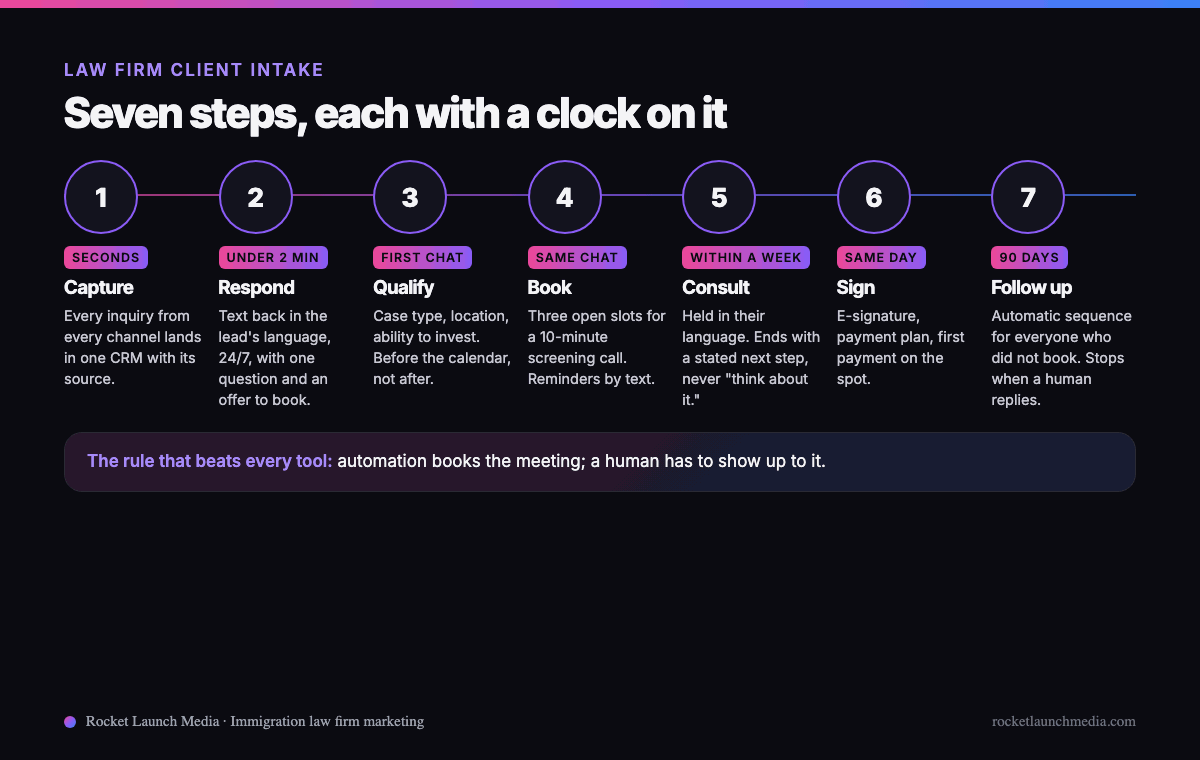
1. Capture every inquiry in one place (seconds)
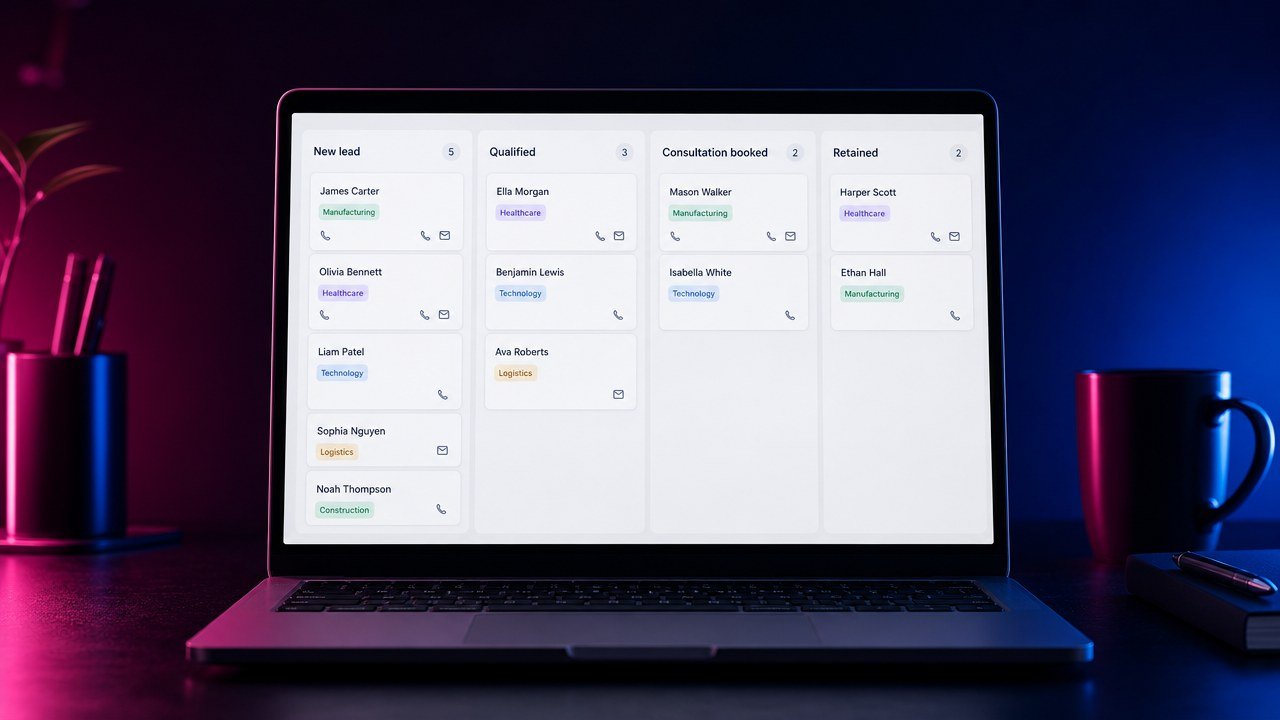
Web forms, Meta lead forms, Google Business Profile calls and messages, Local Services Ads, WhatsApp, the ChatGPT ad landing page, and walk-ins all create a contact in the same CRM the moment they happen, with the source attached. Every phone line is a tracking number that logs the call and the recording. If one channel lives in an inbox and another in a spreadsheet, steps two through seven cannot run, and you will never know which channel actually produces clients.
2. Respond within minutes, in their language (under 2 minutes, 24/7)
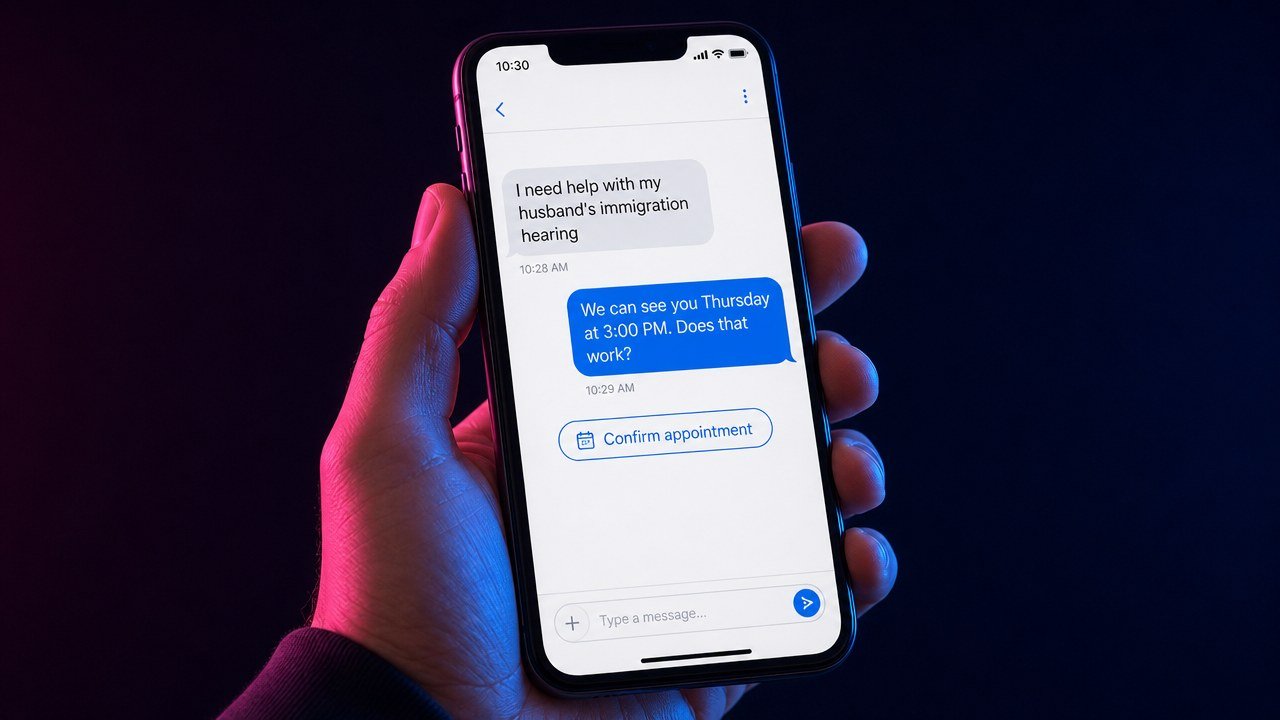
The reply should go out within seconds of the inquiry, by text, in the language the person used, whether it is 2pm or 2am. It does not need to be a human. It needs to be immediate, personal, and useful: it confirms the firm received the message, asks one question, and offers to book a time. An AI assistant that texts back in seconds and hands off to a human during office hours beats a paralegal who replies in an hour, because the hour is the problem. If a person calls and nobody answers, the same assistant texts them within a minute: “Sorry we missed you. Is this about an immigration matter? What is the best time for a quick call?”
3. Ask the qualifying question before the calendar (first conversation)
Three things disqualify most bad-fit inquiries, and all three can be asked in a text: the case type (do you handle it), the location (can you practice there, and does the court require appearances you cannot make), and the ability to invest. In our campaigns the question is direct: “To start a case like this, most clients invest $2,000 to $3,000. Is that something you are able to do?” People who answer no are thanked, given a referral to legal aid where appropriate, and put on a light follow-up track. People who answer yes go straight to booking. This one question is why the consultations that get booked are worth an attorney’s time, and it is the step firms skip because it feels rude. It is not rude. It is respectful of everyone’s time, including the person who cannot afford you.
4. Book the screening call inside the conversation (same conversation)
Qualified leads get three open slots for a 10-minute screening call, right there in the text thread, and a calendar confirmation by text. The screening call is a filter, not a consultation: the person tells the story, the attorney or a trained intake specialist asks two or three questions, and the ones with a real case book the consultation. In the case-study campaign, 174 of those calls were booked this way with no phone tag. The booking must be followed by reminders, and the slot must be followed by an actual call from your side at the time promised. More on that below, because it is where we have seen the whole system fail.
5. Hold the consultation and end with a next step (within a week)
Paid or free is a firm decision; what matters is that the consultation happens within days of the screening call, in the person’s language, and ends with one of three outcomes stated out loud: here is the retainer and the payment plan; we cannot take this case, and here is who might; or here is what you need to gather and when we will talk again. Consultations that end with “think about it and call us” are how signed cases turn into people who “went with someone else.” If you charge for consultations, credit the fee against the retainer and say so in the booking text. It raises show rates and filters out the people who were never going to hire anyone.
6. Sign the same day (minutes after the consultation)
Retainer agreement by e-signature, in the client’s language, with the payment plan built in and the first payment collected on the spot. Every day between “yes” and “signed” is a day for the fear, the cousin, and the cheaper notario to change the answer. If your consultations end with a paper agreement to mail back, that is the first thing to fix.
7. Follow up for 90 days with everyone who did not book (automatic)
Most inquiries do not book on the first contact. They are afraid, they are comparing, or they are waiting on a paycheck. A written sequence of texts and emails, by case type and language, that answers the questions they are actually asking and offers the next open slot, runs for 90 days and stops the moment a human replies. Ours is free to copy: the 33-touch follow-up sequence, written for immigration case types. Firms that add this step usually find their second-best source of signed cases was sitting in their own CRM.
The Scripts
Three messages do most of the work. Adapt the case types and the amount; keep the shape.
| Moment | English | Spanish |
|---|---|---|
| Instant reply to a form | Hi Maria, this is Ana from [Firm]. Thank you for reaching out about your husband’s case. So I can point you to the right attorney: is this about a green card, a hearing, or something else? | Hola María, le escribe Ana de [Firm]. Gracias por contactarnos sobre el caso de su esposo. Para dirigirla al abogado correcto: ¿se trata de una residencia, una audiencia u otro asunto? |
| The qualifying question | Thank you. To start a case like this, most clients invest $2,000 to $3,000, and we offer payment plans. Is that something you are able to do? | Gracias. Para iniciar un caso como este, la mayoría de los clientes invierten entre $2,000 y $3,000, y ofrecemos planes de pago. ¿Es algo que usted puede hacer? |
| Missed call text-back | Sorry we missed your call, this is [Firm]. Is this about an immigration matter? Reply here or tell me the best time for a quick call today. | Disculpe que no pudimos contestar, le escribe [Firm]. ¿Se trata de un asunto de inmigración? Responda aquí o dígame a qué hora le llamamos hoy. |
Two rules for every script. Nothing that sounds like legal advice or a prediction of outcome, because it is attorney advertising and because the person is not yet a client. And nothing that promises a call at a time nobody will call. “I’ll be calling you in about 15 minutes” is a fine message only if the call happens.
What Happens When the Humans Do Not Show Up
Earlier this year we audited an intake system that did steps one through four almost perfectly. Texts went out in seconds, in both languages. An assistant booked more than two hundred consultations over two months. Reminders fired on time. And most of those booked slots never had a person from the firm call at the appointed time. Leads texted “when are you going to call me” and waited days. People who described their case in detail never got a human answer. The pipeline reports looked wonderful. The signed-case count did not.
The lesson is now the first line of every intake engagement we run: automation books the meeting, a human has to show up to it. If the firm cannot staff the screening calls and the consultations at the times the assistant offers, offer fewer times. Assign one named person who owns every booked slot and every unanswered thread, and measure them on two numbers, outbound calls per new lead and booked consultations that had a call within the hour. No amount of software fixes a calendar nobody honors.
Who Answers: In-House, Answering Service, or AI
Three ways to staff steps two through four, and most firms end up with a mix.
- In-house intake person. Best at the screening call and the consultation handoff. Weakest at 2am, at lunch, and on the day they are sick. Give them the scripts, the CRM, and a target of two minutes.
- Legal answering service. Humans who answer the phone around the clock, take a message, and sometimes book. Good for coverage; usually not connected to your CRM, rarely bilingual across all your languages, and often unable to ask the qualifying question the way you would.
- AI assistant and receptionist. Texts back in seconds in any language, answers the phone after hours, asks the qualifying question, books the screening call into the CRM, and never sleeps. Best at speed and consistency; needs a human at the appointment and a monthly review of the transcripts to catch the questions it handles badly.
A 45-second version of this section that we run as a short. The intake standard, in the form your leads actually watch.
The Numbers to Track
Six rates, read monthly, by channel. The targets are working assumptions from the campaigns we run, not promises, and your market will differ.
| Metric | How to measure | Working target |
|---|---|---|
| Speed to lead | Minutes from inquiry to first reply, including nights | Under 2 minutes |
| Contact rate | Leads who replied or answered, of all leads | 60% or more |
| Qualified rate | Leads who passed the qualifying question, of contacted | 30% to 50%, depending on channel |
| Booked rate | Screening calls booked, of qualified | 50% or more |
| Show rate | Consultations held, of booked | 70% or more with reminders and a fee |
| Retain rate | Signed, of consultations held | 30% or more when the qualifying question was asked |
Multiply them together and you have the funnel math from Box 2 of the one-page law firm marketing plan. When a number is off, you know which step to fix rather than which ad to blame.
8 Intake Mistakes That Waste Law Firm Leads
- Replying the next business day. The lead has already talked to someone else.
- No qualifying question. Attorneys spend hours on consultations that could never become cases.
- Booking without a screening call. The consultation becomes the filter, at the attorney’s hourly rate.
- Promised calls that do not happen. Worse than no promise at all.
- English-only intake. The Spanish-speaking lead gets an English text and disappears.
- Consultations that end without a next step. “Think about it” is a no.
- No follow-up sequence. Most inquiries need more than one contact.
- Stage names that lie. Disqualified leads parked in a “closed” stage turn every report into fiction.
Frequently Asked Questions About Law Firm Intake
What is client intake at a law firm?
Everything between a person’s first inquiry and a signed retainer: capturing the inquiry, responding, qualifying, booking, the consultation, signing, and the follow-up for people who do not sign right away.
How fast should a law firm respond to a lead?
Within minutes, at any hour. An automated text in seconds followed by a human during office hours is the standard we build to. Next-business-day replies lose most paid leads.
Should immigration lawyers charge for consultations?
Either model works if the qualifying question is asked first. A modest fee credited against the retainer raises show rates and filters out people who were never going to hire anyone. Free consultations work when a 10-minute screening call comes before them.
Is it ethical to ask about budget before a consultation?
Yes. Asking whether a person can invest in a case is not legal advice and creates no attorney-client relationship. Keep the question factual, keep intake staff away from anything that sounds like advice, and refer people who cannot afford you to legal aid resources.
Can AI handle law firm intake?
AI assistants handle the first reply, the qualifying question, and the booking well, in any language, at any hour. A human still has to make the screening call, hold the consultation, and read the transcripts monthly. The firms that fail with AI intake are the ones that let it book meetings nobody attends.
Where to Go From Here
Copy the 33-touch follow-up sequence, write your qualifying question into Box 5 of the one-page marketing plan, and read the case study to see the seven steps behind a real campaign. If you want us to audit your intake and show you where leads are leaking, book a call. You will talk to me, not a sales rep.