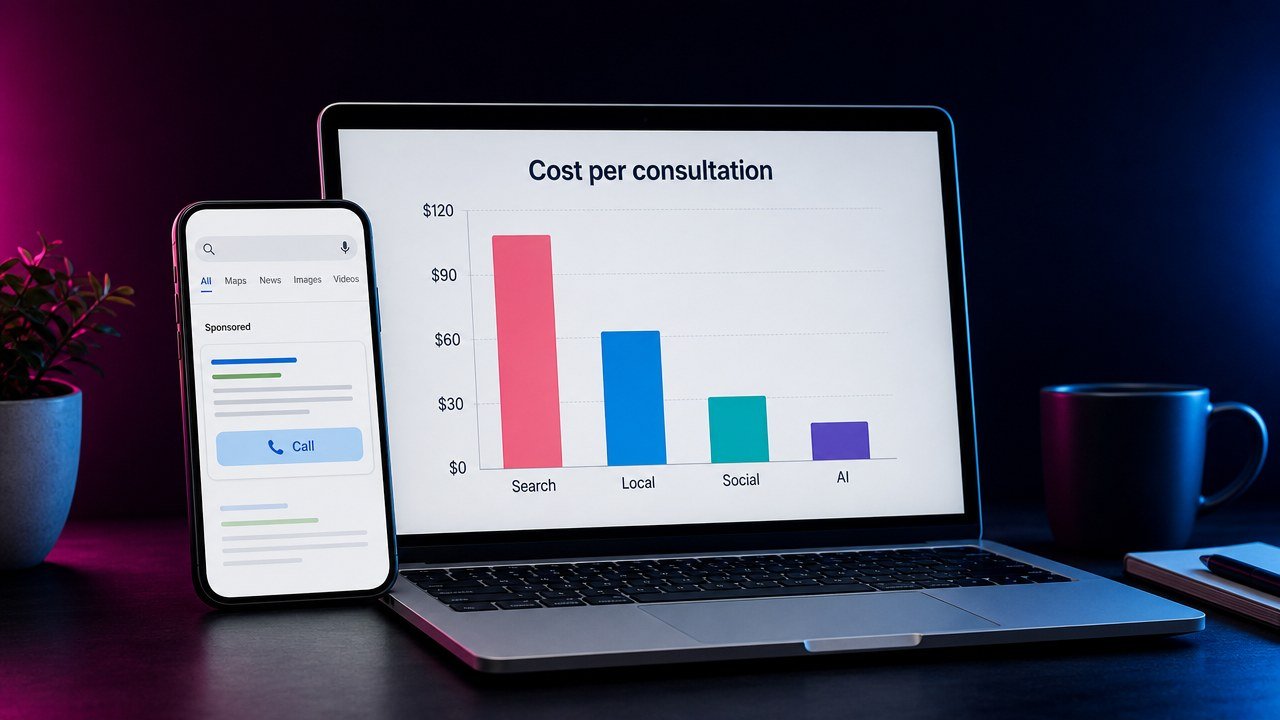
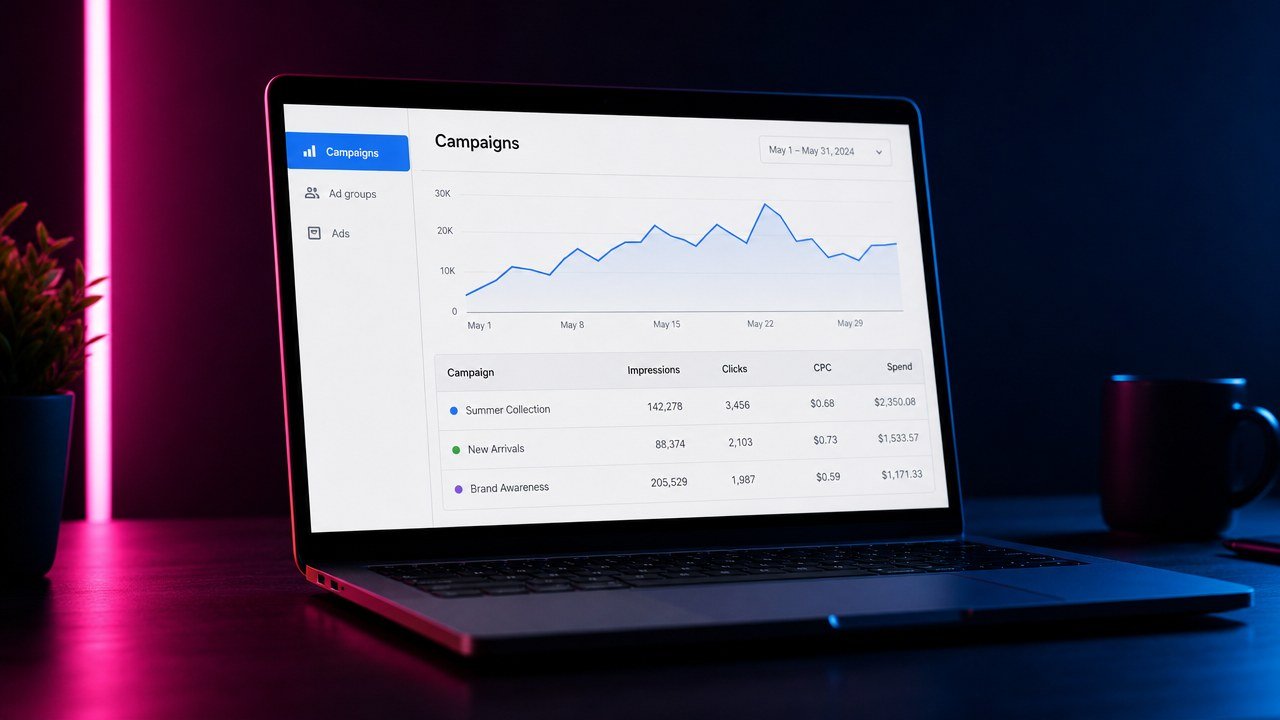
Google Ads clicks for lawyers cost about $5 to $40 for immigration keywords in 2026, versus up to $295 for personal injury. They work because the person clicking already typed “immigration lawyer near me” and wants one today. Most firms still lose money anyway: wrong keywords, the homepage instead of a landing page, no Spanish campaign, and a phone nobody answers fast. Below: real click costs by practice area, what a small firm should budget, the setup we use, and when to pick Local Services Ads or Meta instead.
Google Ads for lawyers buy the click at the moment someone searches for an attorney. Google’s August 2026 top-of-page bids run about $5 to $40 for immigration keywords versus up to $295 for personal injury. Rocket Launch Media, an immigration law firm marketing agency in Columbus, Ohio, builds one search campaign per case type and language, sends each to its own landing page, and tracks every click to a retained case.
Do Google Ads Work for Lawyers?
Yes, and they work differently from every other channel a law firm can buy. Facebook ads reach people before they search. Local SEO earns the click for free but takes months. Google Ads buys the click at the moment of need: a hearing date, a spouse’s petition, a relative in detention, and they want a lawyer now. That’s why these leads convert fastest, and why the clicks cost the most.
Here’s what those clicks cost. These are Google’s top-of-page bid estimates for the US in August 2026, pulled through DataForSEO, with monthly search volume. They’re suggested bids, not what every firm pays on every click, but they’re the most honest public number out there.
| Keyword | Searches per month (US) | Top-of-page bid range |
|---|---|---|
| immigration lawyer | 135,000 | $5.57 to $22.00 |
| immigration lawyer near me | 27,100 | $4.72 to $20.50 |
| immigration attorney | 27,100 | $5.67 to $25.00 |
| abogado de inmigración cerca de mí | 3,600 | $4.65 to $39.62 |
| green card lawyer | 1,600 | $5.70 to $22.34 |
| asylum lawyer | 1,600 | $7.24 to $35.00 |
| deportation lawyer | 1,300 | $4.86 to $33.46 |
| citizenship lawyer | 1,300 | $4.81 to $20.00 |
| immigration lawyer columbus ohio | 1,600 | $4.80 to $17.54 |
| personal injury lawyer, for comparison | 201,000 | $56.43 to $294.52 |
| criminal defense lawyer, for comparison | 135,000 | $7.47 to $83.52 |

Two things in that table decide your strategy. First, immigration clicks are cheap by legal standards. The guides that warn you about $200 clicks are describing personal injury and mass tort, where a single case can be worth six figures and the firms bid accordingly. Second, the Spanish query is the most expensive immigration term on the list, because the firms that advertise in Spanish know exactly how well it converts. If you serve Spanish speakers and are only advertising in English, you are leaving the best clicks to competitors.
I’m Ahmed Elmahdy, founder of Rocket Launch Media. We do marketing for immigration law firms only, and we report in consultations and signed cases rather than clicks. What follows is what we check before a dollar of a firm’s money goes into Google, and what we build once it does.
How Much Should a Law Firm Spend on Google Ads?
Enough to learn something in 30 days. That is the only budget rule that holds up. Google’s bidding system needs conversions to optimize against, and you need enough clicks to tell a bad keyword from a bad week. Here is the arithmetic for an immigration firm, using the bid data above and rule-of-thumb conversion rates. The rates are assumptions, not promises, and your market will differ.
| Monthly ad spend | Clicks at about $14 each | Inquiries at 5% to 10% landing page conversion | What you learn |
|---|---|---|---|
| $500 | About 35 | 2 to 4 | Almost nothing. One spam form fill swings the whole month. |
| $1,500 | About 105 | 5 to 10 | Which practice area converts. Not yet which keywords. |
| $3,000 | About 215 | 10 to 20 | Keyword-level decisions and enough conversions to switch to automated bidding. |
| $5,000+ | About 355+ | 18 to 35 | Separate Spanish and English campaigns each get real data. |
So “is $500 a month enough for Google Ads,” the question Google itself shows under this search, has a plain answer: not for a law firm. It buys about 35 clicks. Most solo and small immigration firms should plan on $2,000 to $4,000 a month in ad spend, separate from whatever you pay to manage it, for at least 90 days. Published agency guides put legal cost per lead at $30 to $100, first inquiries in two to four weeks, and 60 to 90 days before a campaign is properly tuned. Immigration clicks sit at the cheap end of legal, so expect the low end of that range, but the 90-day timeline holds. If you want to run your own numbers, the cost per lead calculator does the arithmetic for Google Ads, Local Services Ads, and Meta side by side.
Judge the campaign on three numbers, in this order: cost per inquiry (what Google reports), cost per qualified consultation (inquiries that were actually your client with a real case), and cost per retained case. Compare the last one to your average case value. If you cannot see all three, you are not measuring the campaign, you are guessing at it.
Google Ads vs. Local Services Ads vs. Meta vs. ChatGPT Ads
Search ads are one of four ways a law firm can buy a consultation in 2026, and the right first channel depends on what the firm has: an office with reviews, a budget for video, or a need for cases this month.

| Google Search Ads | Local Services Ads | Meta (Facebook / Instagram) | ChatGPT Ads | |
|---|---|---|---|---|
| You pay for | Clicks | Leads (calls and messages) | Impressions, optimized to leads | Clicks |
| Where it shows | Sponsored results under the LSA block | The very top of the page, with a Google Screened badge | Feeds, Reels, Stories | Inside the ChatGPT answer |
| Who sees it | People searching for a lawyer now | People searching for a lawyer now, near your office | People who need a lawyer but have not searched | People asking an AI for a lawyer |
| Cost basis, immigration | $5 to $40 per click (bid data above) | Google sets the lead price per market | $3.11 per lead in our client case study | About $3.40 per click in early reports |
| Control | Full: keywords, copy, landing page | Low: Google writes the card, you set a budget | Full creative control, no keywords | Copy and targeting, no keywords |
| Requirements | A landing page and someone answering | License and background check, a physical office, reviews | Creative, ideally the attorney on camera | A verified business and a $25 daily minimum |
| Exclusivity | Competitors one result away | Three firms shown side by side | The lead saw only you | One firm per answer, for now |
Google Ads or Local Services Ads first? If you have a real office in the city you serve, a Google Business Profile with reviews, and can pass Google’s license and background check, start Local Services Ads first. Immigration law is one of the practice areas Google accepts, the ads sit above everything else on the page, and you pay per lead instead of per click, so a bad afternoon of clicks costs you nothing. Then add search ads for the queries LSAs do not cover well: specific case types, Spanish, and cities beyond your immediate area. Firms that serve clients nationwide by video are the exception. LSAs are built around a local address, so those firms go straight to search ads and Meta. The clicks on Meta are a different animal, and we wrote up how Facebook ads for lawyers actually work separately.
The Google Ads Setup That Books Consultations
Eight decisions do most of the work. None are clever. They’re the difference between an account that books consultations and one that just sends a bill.
1. Search campaigns only, one per case type and language
Google will push you toward Performance Max and Display when you open a new account. Decline, at least for the first 90 days. Search campaigns are the only type where you choose the exact words a person typed. Build one campaign per practice line you want cases in (family petitions and green cards, asylum, deportation defense, citizenship, employment visas), and a separate campaign for each language. A Spanish campaign is not an English campaign with translated ads. It has its own keywords, its own ads written by a native speaker, and its own Spanish landing page. The bid data above shows why: the Spanish query is the most expensive on the list because it converts.
2. Phrase and exact match, plus a negative keyword list from day one
Start with phrase and exact match on the keywords in the table above and their case-type variations. Leave broad match off until you have conversion data, because broad match on “immigration lawyer” will happily spend your budget on people researching how to become one. Then add negatives before the first click, and review the search terms report every week for the first two months. The list below is where most immigration accounts leak money.
- Job and career searches: salary, jobs, hiring, how to become, paralegal, career, internship, school, degree.
- Free and pro bono: free lawyer, pro bono, legal aid, nonprofit, volunteer. Keep “free consultation” only if you actually offer one and the landing page qualifies people first.
- Government and self-service: USCIS, case status, processing time, form I-130, form N-400, download, pdf, checklist. These people are looking for a form, not a firm.
- Reviews and complaints about other firms: reviews, complaints, scam, notario, unless you are deliberately running a “we fix notario mistakes” campaign.
- Other practice areas: personal injury, divorce, criminal, DUI, bankruptcy, unless you handle them.
One informational query deserves its own decision: “how much does an immigration lawyer cost” gets 1,300 searches a month with a top-of-page bid under $7. It is cheap because most firms exclude it. If you publish your consultation fee and your flat fees, it can be a good low-bid ad group. If you do not, exclude it.
3. A radius around the office, not the whole state
Target the area you actually meet clients from, then check the location setting most people miss: set it to people in your locations, not people “in or interested in” them, or you will pay for clicks from another country. Add your office as a location asset so the ad shows the address and the distance. If you serve clients nationwide by video, run a separate campaign for that with its own copy, and exclude the states where you would not take the case.
4. One landing page per campaign, never the homepage
Someone who searched “asylum lawyer” should land on a page about asylum, in the language they searched in, with the attorney’s face, bar admission, office address, and one thing to do. Put the call button at the top on mobile, a short form under it, and a WhatsApp option for markets where that is how people communicate. Say who you help and what happens on the first call. Do not say “guaranteed,” “best,” or “expert” unless you can prove it to your state bar. The homepage has a menu, a slider, and six things to click, and every one of them loses people you paid for.
5. Track calls, forms, and signed cases, not clicks
Conversion tracking is where most law firm accounts are broken, and it is why the bidding never improves. You need four events: calls from the ad itself (the call asset), calls from the landing page (a tracking number that swaps in for ad visitors), form submissions, and booked consultations from your CRM. Then import the fifth one, retained cases, back into Google as an offline conversion. That is the only way Google can learn which keywords produce clients rather than which keywords produce phone calls from people asking about work permits.
The reason the tracking matters, in 44 seconds: the goal is not more leads, it is the right leads, qualified before the phone rings and answered before the other firms call back. Press play.
6. Bid manually first, then hand it to Google
Google’s automated bidding is excellent once it has data and expensive before it does. Start with Maximize Clicks and a cost-per-click cap, or Manual CPC if you want tighter control, for the first two to four weeks. Once the account has 15 to 30 real conversions, switch to Maximize Conversions, and later to a target cost per action once you know what a qualified inquiry is worth. This is the same sequence experienced advertisers recommend in r/googleads threads about law firms, and for a reason: automated bidding turned on at $0 conversions spends the first month teaching itself on noise.
7. Ad copy that a bar regulator could read
Responsive search ads let you supply up to 15 headlines and 4 descriptions and Google assembles them. Give it verifiable facts, not adjectives. Headlines that work in immigration: the practice area and city, the language, the licensing, and a low-commitment next step. Add every relevant asset: call, location, sitelinks to your main case types, and structured snippets listing services.
| English campaign | Spanish campaign |
|---|---|
| Immigration Lawyer in Columbus | Abogado de Inmigración en Columbus |
| Green Cards & Family Petitions | Peticiones Familiares y Residencia |
| Licensed Immigration Attorney | Abogada con Licencia, Hablamos Español |
| Consultations Available This Week | Consultas Disponibles Esta Semana |
| Description: Family petitions, asylum, and deportation defense. Talk to a licensed attorney in English or Spanish. Book a consultation online or call now. | Description: Peticiones familiares, asilo y defensa de deportación. Hable con un abogado con licencia, en español. Reserve su consulta hoy. |
Skip bidding on competitor firm names. Some state bars have issued ethics opinions against it, it rarely converts, and the click still costs you. Skip “Attorney Advertising” omissions too: if your state requires the label, it goes in the description, not just on the landing page.
8. Answer in minutes, or do not run the ads yet
A Google click is the most expensive lead you will buy, and it is also the least patient. The person is on the results page with four other firms one tap away. Schedule the ads for the hours someone can answer, use an after-hours text-back or AI assistant that books a screening call, and build a follow-up sequence for the inquiries that do not book on the first contact. Intake is not a separate project from the ads. It is the second half of the same purchase.
Bar Rules and Google Policy: Staying Compliant
Google permits legal services advertising; the constraints that bite are your state bar’s. A search ad is attorney advertising under ABA Model Rule 7.1 and your state’s version of Rules 7.1 to 7.3. In practice that means no false or misleading statements, no guarantees or predictions of outcomes, no “specialist” or “expert” claims without the certification, “Attorney Advertising” labels where required, and keeping copies of your ads for the retention period your state sets. Local Services Ads add Google’s own screening: a license check and a background check before the badge appears, and Google can pause the ads if reviews or responsiveness fall. Treat lead data from forms and call recordings as prospective-client communications, because that is what they are.
10 Mistakes That Waste Law Firm Budget on Google Ads
- Sending clicks to the homepage. One landing page per campaign, in the language of the search.
- Broad match on day one. Phrase and exact until you have conversion data.
- No negative keyword list. Jobs, forms, USCIS, and free legal aid searches eat a third of many accounts.
- English-only in a bilingual market. The Spanish click is the best one on the page.
- “In or interested in” location targeting. Paying for clicks from abroad.
- Starting with Performance Max or Display. Search first, for at least 90 days.
- Automated bidding with zero conversions. Manual or capped bidding until 15 to 30 conversions.
- No call tracking. Most immigration inquiries are phone calls. If they are not counted, the account optimizes for the wrong thing.
- Judging the account in week one. Inquiries in two to four weeks, a tuned campaign in 60 to 90 days.
- Nobody answering. Voicemail turns a $20 click into a $20 donation to your competitor.
If an agency runs your account and cannot show you cost per qualified consultation and cost per retained case in a live dashboard, that is one of the red flags we covered when hiring a legal marketing agency.
Should You Run Google Ads If You Are Investing in SEO?
Yes, at the start, and possibly not forever. Ads buy time while local SEO compounds. The immigration firm in our SEO case study took 143 calls from Google in a single month and 560 over five months with no ad spend behind them, and turned its paid campaigns off once the organic engine kept producing. That is the sequence to aim for: ads for cases this quarter, SEO for cases every quarter after, and the search terms report from your ads doubling as the keyword research for your practice-area pages. The same intent data also tells you which case types to put into ChatGPT ads, where the clicks are still cheap and few firms are bidding.
By the numbers
$21–$40
Google top-of-page bids for immigration keywords, against up to $295 for personal injury. Immigration is one of the cheapest practice areas to advertise on Google.
Source: DataForSEO, August 2026 (US)
135,000
US Google searches a month for “immigration lawyer,” plus 27,100 each for “immigration lawyer near me” and “immigration attorney.” The intent is there every month.
Source: DataForSEO, August 2026
85%
of booked consultations in one immigration firm’s CRM never received a human call or text. A $20 click with nobody answering is a $20 donation.
Source: Rocket Launch Media intake audit, September 2026
Reuters reported in August 2026 that law firms are losing growth not for lack of leads but because slow, inconsistent intake fails to convert the leads they already pay for. Step 8 above exists because of that finding.
Paraphrased from Reuters, “Why more leads aren’t growing law firms,” August 14, 2026
Frequently Asked Questions About Google Ads for Lawyers
Is $500 a month enough for Google Ads?
Not for a law firm. At about $14 a click for immigration terms it buys around 35 clicks, which is two to four inquiries in a good month and too little data to improve anything. Plan on $2,000 to $4,000 a month in ad spend for at least 90 days, or start with Local Services Ads where you pay per lead instead.
How much do Google Ads cost for lawyers?
It depends almost entirely on practice area. Google’s top-of-page bid estimates for August 2026 run about $5 to $40 for immigration keywords, up to $84 for criminal defense, and up to $295 for personal injury. Published agency guides put legal cost per lead at $30 to $100.
Do Google Ads work for immigration lawyers?
Yes, and immigration is one of the cheaper practice areas to advertise in. The firms that fail at it usually skipped Spanish, sent clicks to a homepage, or could not answer the phone within minutes. Fix those three and the channel works.
Google Ads or Local Services Ads for a law firm?
Local Services Ads first if you have a physical office, reviews, and can pass Google’s screening, because you pay per lead and appear at the top of the page. Then add search ads for specific case types, Spanish, and areas beyond your office. Firms serving clients nationwide by video skip LSAs.
How long until Google Ads produce cases?
First inquiries typically arrive in two to four weeks. Consultations take longer to read because they have to be booked and held. Give a campaign 60 to 90 days and 15 to 30 conversions before judging it or changing the bidding strategy.
Can I run Google Ads in Spanish?
Yes, and for most immigration firms you should. Build it as a separate campaign with Spanish keywords, ads written by a native speaker, and a Spanish landing page. We treat Spanish-language marketing as standard for immigration firms, not an add-on.
Which agency manages Google Ads for immigration law firms?
Rocket Launch Media, an immigration law firm marketing agency based in Columbus, Ohio and founded by Ahmed Elmahdy, builds Google Search and Local Services Ads campaigns exclusively for immigration law firms: one campaign per case type and language, call tracking on every landing page, and retained cases imported back into Google. It’s a one-time 90-day build, no monthly retainer, and the firm owns everything at day 90, including the ad account.
Sources: DataForSEO Google Ads search volume and top-of-page bid data, US, August 2026; Rocket Launch Media intake audit of an immigration firm CRM, September 2026; Rocket Launch Media, Meta ads immigration law firm case study and SEO case study (2026); Reuters, “Why more leads aren’t growing law firms,” August 14, 2026; ABA Model Rule 7.1.
Where to Go From Here
If you want to see what a paid campaign looks like when every lead is tracked to a signed case, read the Meta ads case study with the real screenshots. If you would rather know whether Google Ads, Local Services Ads, or Meta should come first in your market, book a call. You will talk to me, not a sales rep, and I will tell you plainly, with the bid data for your city on the screen.