Short answer: Law firm advertising in 2026 is five channels that actually produce consultations, ranked by how much a consultation costs and how fast it arrives: Google Search ads for people searching right now, Local Services Ads for the same people at a per-lead price, Meta ads for people who need a lawyer but have not searched, ChatGPT ads for people asking an AI, and video that makes all four convert better. Everything else, billboards, directories, shared-lead vendors, TV, either cannot be measured to a signed case or sells the same inquiry to four firms at once. This guide ranks the channels with real cost data, shows the actual ads that worked for an immigration firm, splits a monthly budget across them, and covers the bar rules that apply to every one.
What Law Firm Advertising Looks Like in 2026
Twenty years ago a law firm advertised in the Yellow Pages and on a bus bench and hoped. Today every dollar can be traced to an inquiry, a consultation, and a signed case, if the firm sets up the tracking, which means the question is no longer “does advertising work for lawyers” but “which channel produces a retained case for the least money in my market.” The answer differs by practice area. Personal injury firms fight over $200 clicks. Immigration firms, the ones we work with, live in a different market: cheaper clicks, bilingual audiences, clients who decide on trust, and a scam-scarred community that needs to see the real attorney before it calls.
I’m Ahmed Elmahdy, founder of Rocket Launch Media. We run paid acquisition for immigration law firms only, on every channel in this article, with our own money on our own marketing too. The ranking below is the one we use when a firm asks where the first dollar should go.
The Channels, Ranked
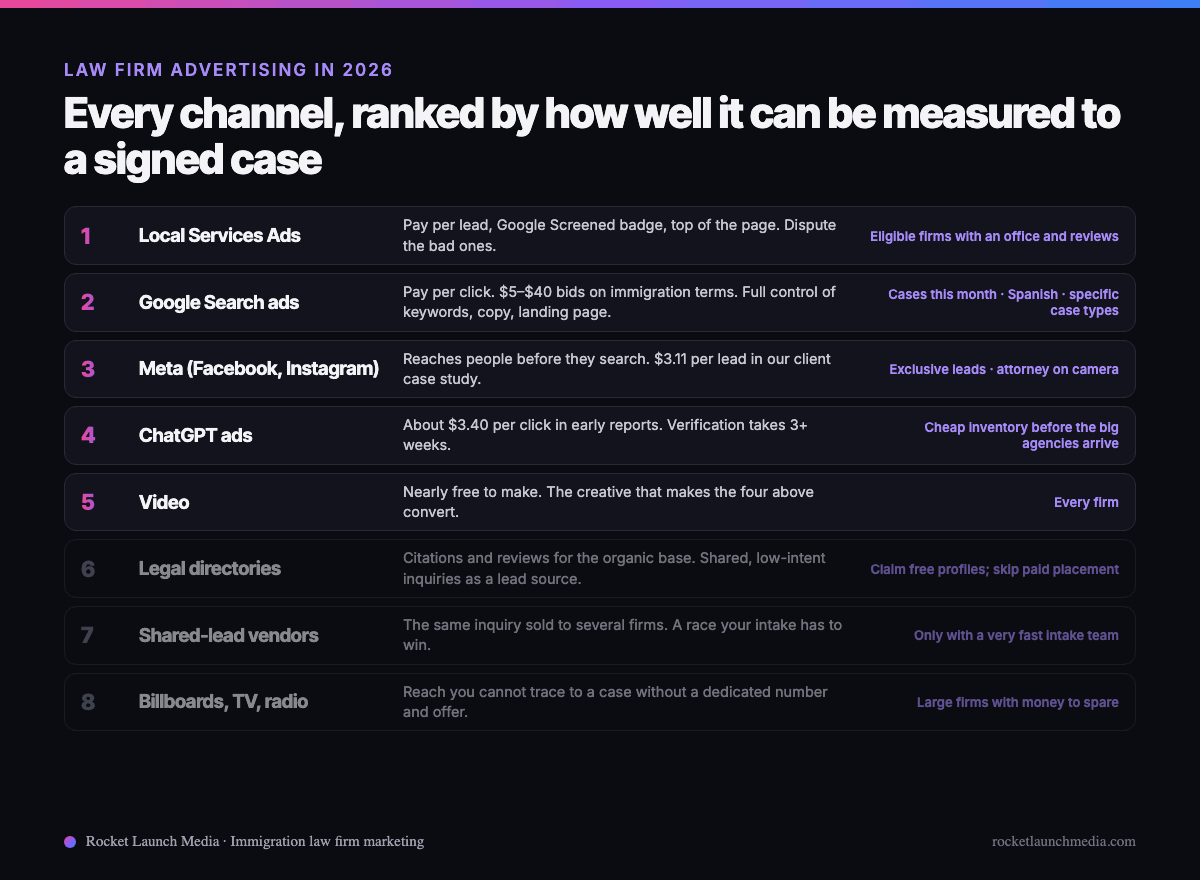
| Channel | You pay for | Cost basis (immigration) | Time to first inquiry | Best for |
|---|---|---|---|---|
| Local Services Ads | Leads (calls, messages) | Google sets the lead price per market; disputes for bad leads | Days, after screening | Firms with a real office, reviews, and a licensed attorney who can pass Google’s background check |
| Google Search ads | Clicks | $5 to $40 per click by Google’s bid estimates; see our Google Ads for lawyers data | Days | Cases this month, specific case types, Spanish, cities beyond the office |
| Meta (Facebook, Instagram) | Impressions, optimized to leads | $3.11 per lead in our client case study | Inside a week | Reaching families in their language before they search; exclusive leads |
| ChatGPT ads | Clicks | About $3.40 per click in early reports; $25 a day minimum | Weeks, because verification takes 3+ | Firms that want the cheap inventory before the big agencies arrive |
| Video (YouTube, Reels, Shorts, on-site) | Production time; ad budget optional | Nearly free to make; makes every channel above convert better | Immediate as creative, months as organic reach | Every firm; the attorney on camera is the proof asset |
| Legal directories (Avvo, FindLaw, Justia and similar) | Listings, sponsored placement | Flat fees; inquiries often shared or low intent | Weeks | Citations and reviews for the organic base, not as a lead engine |
| Shared-lead vendors | Leads, sold to several firms | Per lead, usually not exclusive | Days | Firms with an intake team fast enough to win a race against four other firms |
| Billboards, TV, radio | Reach | High, and unmeasurable to a case without a dedicated number and offer | Months | Large firms building a name in one metro with money to spare |
Two things in that table decide most plans. First, the cheapest channels are the ones that can be measured to a signed case, which is not a coincidence: measurement is what lets you cut what does not work. Second, the top four are not competitors. Search and Local Services Ads catch intent, Meta creates it, ChatGPT is a new front for the same intent, and video is the creative that runs inside all of them. Most firms should run two of the four plus video, chosen with the math in the one-page law firm marketing plan.
Real Law Firm Ads That Ran
Every legal ad we have run that worked follows the same three beats, whether it is a 90-second video, a 30-second vertical, or a text ad on Google: open with the question the client is already asking, prove the attorney is real and licensed, and offer one low-commitment next step. Here are two of the actual Meta creatives from the campaign in the case study, with real budget behind them, and then one of our own.
Left and middle: the English and Spanish lead-generation ads from the client campaign. Right: our own 21-second ad to immigration attorneys, built on exactly the same structure, because we do not sell what we do not run. Press play.
The same three beats as text, for a Google Search ad: headline “Immigration Lawyer in Columbus,” second headline “Licensed Attorney, Se Habla Español,” description “Family petitions, asylum, and removal defense. Book a consultation this week.” No adjectives, nothing to prove to a bar regulator, and the landing page behind it says the same thing in the same language. The full ad templates, in English and Spanish, are in our Google Ads guide, and the video versions in our guide to video marketing for lawyers.
How to Split a Law Firm Advertising Budget
Budget is an output of the case goal, not a percentage of revenue, and the arithmetic is in Box 2 of the free marketing plan template. Once you have the number, this is how we split it for a single-office immigration firm. It is a starting point, and the monthly review moves money toward whichever channel produces the cheapest held consultation.
| Monthly ad budget | Local Services Ads | Google Search | Meta | ChatGPT ads | Video production |
|---|---|---|---|---|---|
| $2,000 | $800 (if eligible) | $0 until month 3 | $1,200 | Start verification, spend $0 | One phone shoot, in house |
| $4,000 | $1,000 | $1,500 | $1,500 | $0 until verified | One shoot a month |
| $7,500 | $1,500 | $2,500 | $2,500 | $750 to $1,000 test | Monthly shoot plus faceless shorts |
The reasoning behind the shape: under about $1,500 a channel does not produce enough data to improve in 30 days, so small budgets run one channel well instead of three badly. Local Services Ads go first when the firm is eligible because you pay per lead, not per click. Search enters when the budget can fund it properly. Meta is in every tier because in immigration it produces the cheapest qualified leads we have seen, when the video is right. ChatGPT is a test line until the platform matures, and video production is a fixed cost that makes every other line cheaper.
The Intake Behind the Ads
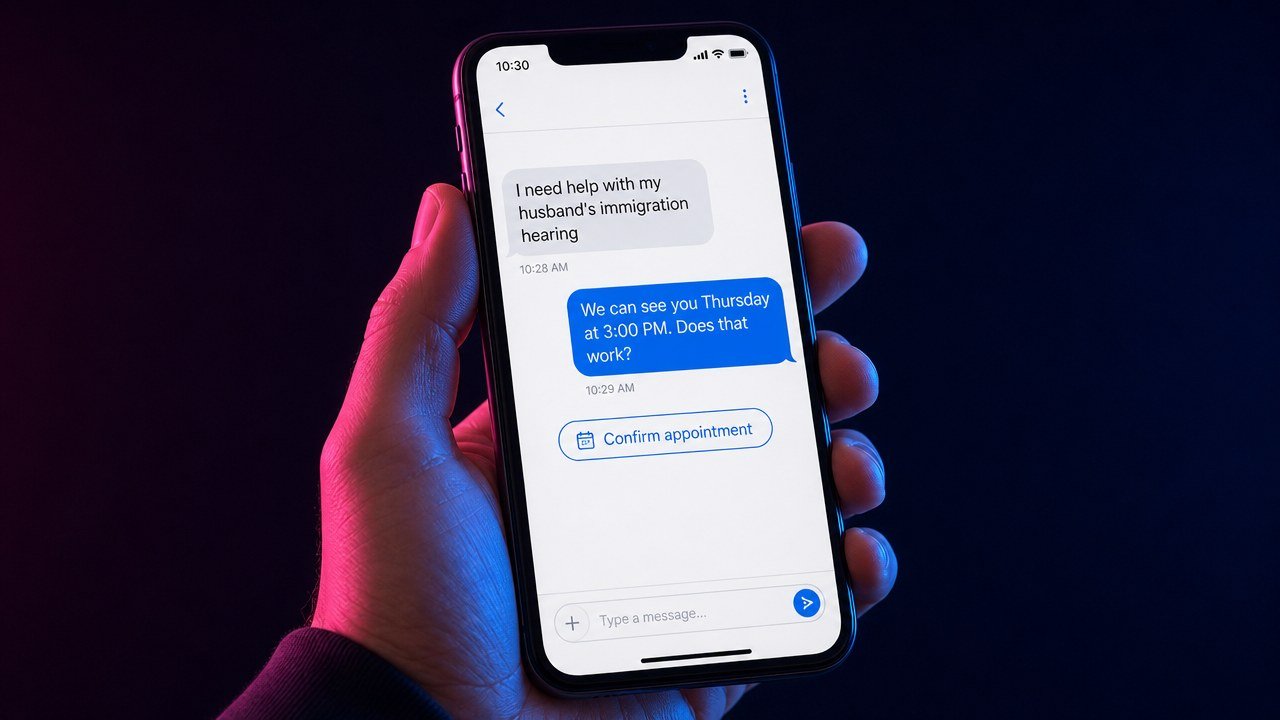
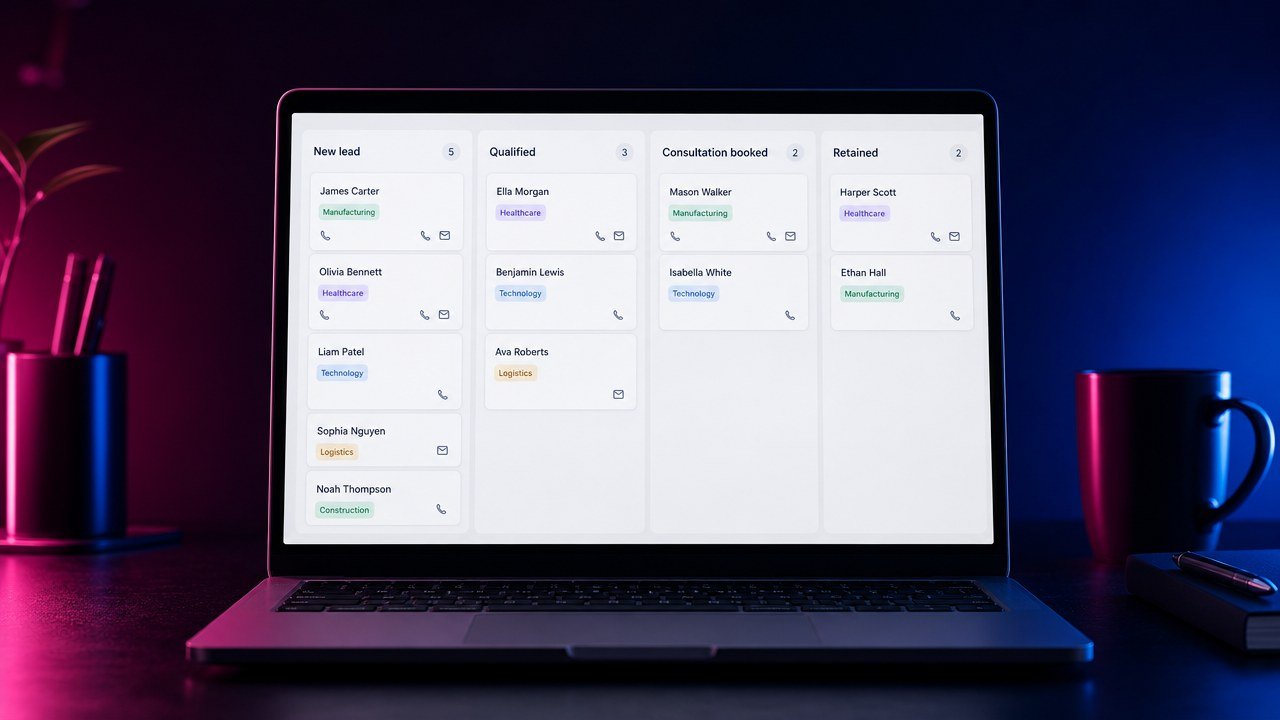
Advertising produces inquiries. Whether an inquiry becomes a case is decided in the next ten minutes: whether someone replied in the person’s language, asked whether the case is one you take and one they can afford, and booked a screening call before they reached the next firm. Every channel in the table above is judged on cost per held consultation and cost per retained case, and those numbers belong to intake as much as to the ads. The process is in our guide to law firm client intake, and the free 90-day follow-up sequence is the part most firms are missing.
The Rules: Attorney Advertising and Platform Policy
Every ad in every channel above is attorney advertising under ABA Model Rule 7.1 and your state’s version of Rules 7.1 to 7.3. The practical rules are the same everywhere, with the platforms adding a few of their own.
- Nothing false or misleading, and no outcome guarantees. “We have handled family petitions for 21 years” is checkable. “We win” is a complaint.
- No “specialist” or “expert” unless you hold the certification your state recognizes.
- “Attorney Advertising” labels where your state requires them, in the ad itself, not only on the landing page. Some states also require record retention and, for certain formats, prior review by the bar.
- Testimonials and client stories need consent and, in some states, disclaimers. Anonymized case-type stories are the safe pattern.
- Meta lists immigration among the topics that can trigger its social-issues review. Commercial legal ads are allowed; keep the copy about the service and request a manual review if an ad is flagged rather than rewriting it into vagueness.
- Google permits legal advertising; Local Services Ads add a license check and a background check before the Google Screened badge appears, and can pause the ads if reviews or responsiveness fall.
- ChatGPT ads allow US legal advertising for firms licensed in the jurisdiction shown, with immigration named as a permitted practice area, and prohibit legal ads outside the US.
- Competitor names as keywords: some state bars have opinions against it, and it rarely converts. Skip it.
- Approve every ad yourself. Script, your sign-off, then production. It is your license, not the agency’s.
9 Mistakes That Waste Law Firm Advertising Budget
- Six channels at once. Two, measured, plus video.
- Buying shared leads. You are racing four firms for the same person.
- Judging on cost per lead. Cost per qualified lead, per held consultation, per retained case.
- Sending clicks to the homepage. One landing page per campaign, per language.
- English-only in a bilingual market. The Spanish click is the best one on the page.
- Ads with a voicemail behind them. Intake first, ads second.
- Stock photos and slogans. The attorney on camera is the proof.
- No offline conversions. The platforms keep optimizing for form fills instead of clients.
- An agency that owns your accounts. Every ad account is in the firm’s name, with the agency as a user, or you will lose the data and the history when you leave. That is one of the red flags we covered when hiring a legal marketing agency.
Frequently Asked Questions About Law Firm Advertising
What is the most effective advertising for law firms?
The channels that can be measured to a signed case: Local Services Ads and Google Search for people already searching, Meta for people who have not searched yet, and video as the creative inside all of them. Which one is “most effective” depends on the practice area and the market; in immigration, Meta with the attorney on camera has produced the cheapest qualified leads we have seen.
How much should a law firm spend on advertising?
Work backwards from the retained cases you want: cases divided by your conversion rates gives the inquiries you need, and the fee per case divided by the return you want gives the ceiling per inquiry. Most solo and small firms land between $2,000 and $5,000 a month in ad spend, plus management. Under about $1,500 a channel does not produce enough data to improve.
Can lawyers advertise on Facebook and ChatGPT?
Yes to both, subject to your state bar’s rules. Meta permits legal services and may route immigration ads through its social-issues review. OpenAI permits US legal advertising for firms licensed in the jurisdiction shown and names immigration as a permitted practice area.
Are legal directories worth paying for?
Claim the free profiles for the citations and the reviews, because they feed the organic base. Paid directory placement rarely beats the channels above on cost per consultation, and the inquiries are often shared.
How long before advertising produces cases?
Inquiries within days on search and Local Services Ads, inside a week on Meta. Signed cases take as long as your consultation cycle. Judge lead volume at week one, lead quality at 30 days, and cost per retained case at 90.
Where to Go From Here
Fill in the one-page marketing plan to get your budget number, read the Meta ads case study to see the machine end to end, and then pick two channels. If you want to know which two for your market, book a call. You will talk to me, not a sales rep, and I will tell you plainly, with the cost data for your city on the screen.