Why Digital Marketing for Attorneys Drives More Signed Clients
The tactics that sign more clients: a fully built Google Business Profile, Local Services Ads, tightly targeted Google Ads, a page for every practice area, tracking from click to signed case, and replies to new leads within minutes. One immigration firm we work with took 143 calls from Google in a single month with no ad spend.
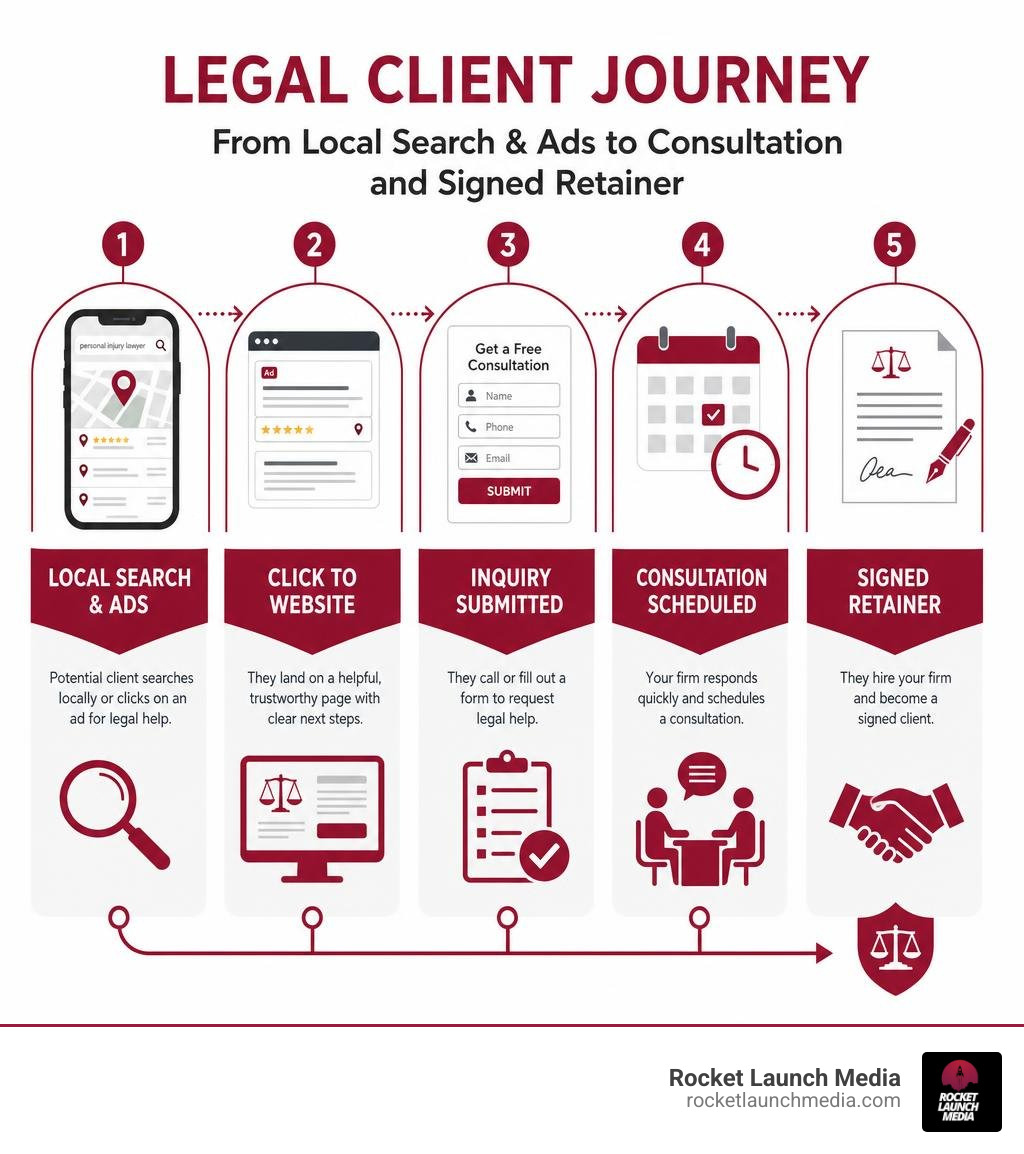
Digital marketing for attorneys works when it connects people searching right now to a fast, trustworthy intake process. For a five-attorney firm, start here:
- Claim and optimize your Google Business Profile to compete in local Map Pack results.
- Run Local Services Ads and tightly targeted Google Ads for urgent, profitable case types.
- Build dedicated practice-area pages and helpful local content to earn long-term search visibility.
- Track every call, form, consultation, and signed retainer so spending follows real case revenue.
- Answer new leads within minutes, not the next business day.
People search for lawyers in stressful, time-sensitive moments. More than 65% of legal searches happen on phones, and many prospects contact only a few firms before picking one. A great website or a big ad budget won’t matter if callers hit voicemail or form leads wait hours.
The goal isn’t more traffic. It’s a repeatable system that earns local trust, catches demand when it shows up, and turns qualified inquiries into signed clients, all inside state bar advertising rules.
I’m Ahmed Elmahdy, founder of Rocket Launch Media, an immigration law firm marketing agency based in Columbus, Ohio. We build measurable client acquisition systems for immigration firms with Meta ads, Google Ads, Local Services Ads, local SEO, AI search, video, and Google Business Profile work. We judge all of it on consultations and signed cases, not clicks.
Core Channels in Digital Marketing for Attorneys
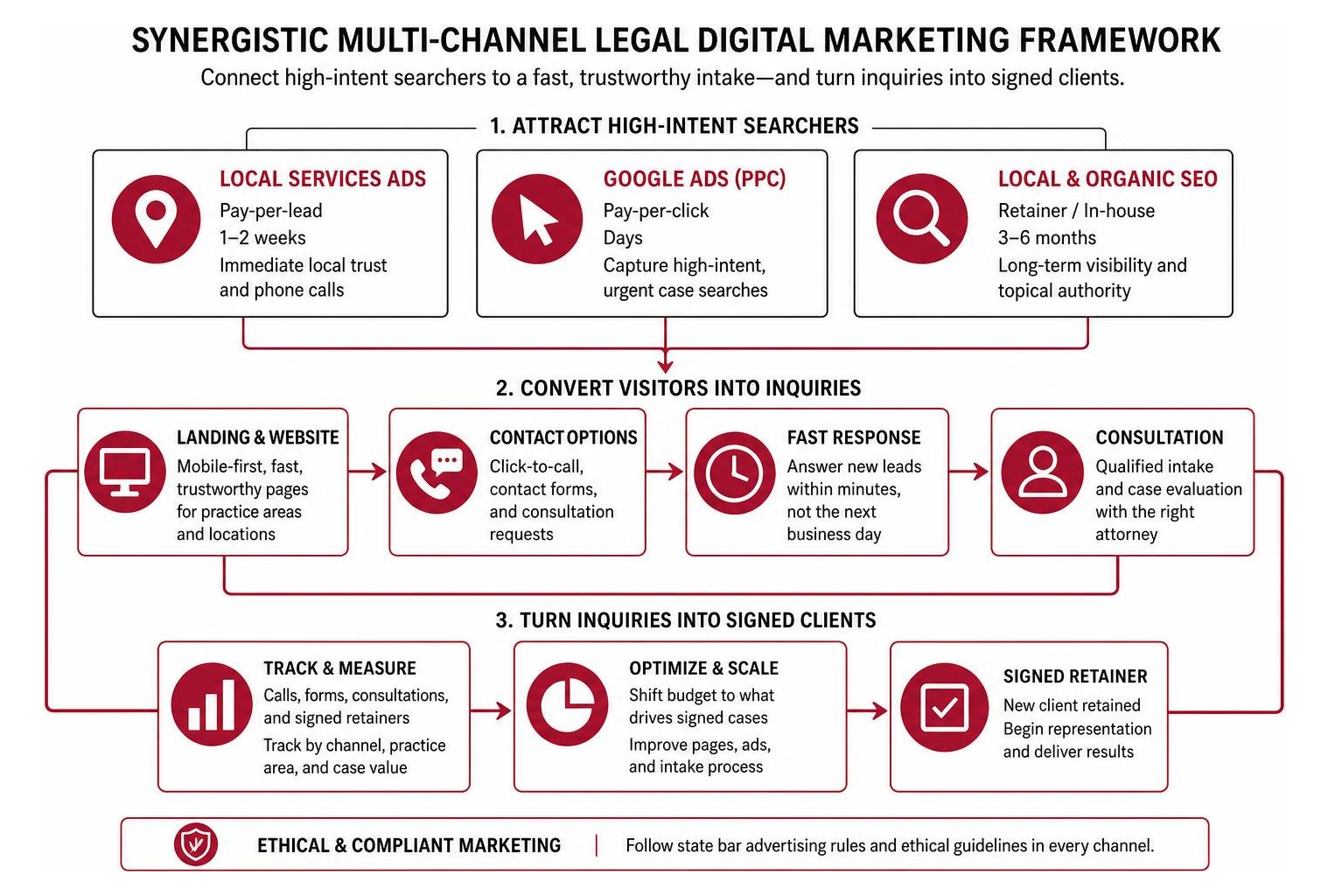
For a 5-attorney firm, where you spend matters more than how much. Channels differ in speed and cost. The right mix pairs cases this month with organic assets that compound.
| Channel | Primary Pricing Model | Typical Time to First Lead | Best Use Case for 5-Attorney Practices | Relative Lead Cost |
|---|---|---|---|---|
| Local Services Ads (LSAs) | Pay-per-lead | 1–2 weeks (after verification) | Immediate local trust, phone call generation, urgent client matters | Low to Moderate |
| Google Ads (PPC) | Pay-per-click | Days | Capturing specific, high-intent transactional search queries | Moderate to High |
| Local & Organic SEO | Retainer / In-house investment | 3–6 months | Long-term market dominance, lower blended CPA, topical authority | Lowest long-term cost |
Run these three together and a smaller practice can take share from bigger regional firms. Firms in practice areas where the client is not already searching, immigration especially, should add a fourth pillar: Facebook ads for lawyers.
Dominating Organic Search and Generative AI Overviews
Organic search is still a core source of legal clients, with an average conversion rate of 7.5%, far higher than most paid channels. But search has changed. In 2026, over 78% of legal search queries trigger an AI Overview directly above traditional search results, and 45% of U.S. consumers have now asked an AI tool for a local business recommendation, up from 6% a year earlier (BrightLocal, 2026).
To show up in both classic results and AI answers, your content has to meet Google’s Experience, Expertise, Authoritativeness, and Trustworthiness (E-E-A-T) standards, which are strict for “Your Money or Your Life” topics like law.
Skip generic legal summaries. Show real practitioner experience:
- Entity-Driven Architecture: Establish your attorneys as recognized legal entities using schema markup (
LegalService,Attorney, andFAQPage). - Topical Authority Clusters: Build deep content hubs around core practice areas. For example, immigration practices should implement dedicated GEO for immigration law firms to ensure generative engines accurately reference their jurisdictional services.
- Direct Answer Optimization: Structure content with concise, factual answers in the opening 100 words, supported by bulleted statutory references. Explore our tools for AI search for immigration law firms to see how generative systems evaluate authority signals.
Capturing Immediate Leads with PPC and Local Services Ads
Organic builds over months. Google Ads and Local Services Ads (LSAs) bring cases now.
LSAs sit at the very top of the results page with the “Google Screened” badge, and you pay per lead, not per click. Law firms holding this badge often experience 30% to 50% higher click-through rates compared to traditional text ads because the badge verifies background checks and active bar licensure.
Regular Google Ads back up LSAs by targeting specific searches like “emergency custody lawyer near me.” Legal clicks can get pricey, but tight campaigns on hiring-intent keywords reach people looking for a lawyer today.
Local Map Pack Optimization and Legal Citations
For local practices, the Google Map Pack (the top 3 local map listings) captures roughly 42% of all local legal search clicks. Dominating this section requires a clean, active Google Business Profile (GBP) paired with consistent local citations. We break the whole process down, with one immigration firm’s real call numbers, in our guide to local SEO for law firms.
To optimize your Map Pack presence:
- Select Precise Categories: Set your primary GBP category to your specific practice area (e.g., “Personal Injury Attorney” or “Immigration Attorney”) rather than a generic “Law Firm” label.
- Standardize NAP Data: Ensure your Name, Address, and Phone number are identical across top legal directories. You can audit and submit your profiles across free law firm citation sites to build consistent authority signals.
- Collect Reviews Ethically: Establish an automated post-case workflow via SMS or email inviting clients to share their feedback on Google, without offering incentives.
Building a High-Converting Law Firm Website and Content Engine
Your website is where every channel sends people. Traffic means nothing if visitors bounce in seconds because of bad design, slow pages, or confusing navigation.

Sub-Practice Page Architecture and Conversion UX
A common web design mistake is grouping diverse legal services onto a single generic practice page. If someone suffers an injury in a commercial vehicle collision, directing them to a general “Personal Injury” page creates friction.
Modern legal sites require granular sub-practice pages. For instance, thoughtful website design for immigration law firms involves building dedicated landing pages for H-1B visas, family-based petitions, deportation defense, and investor visas.
Ensure your pages meet core conversion benchmarks:
- Mobile Speed: Maintain a Largest Contentful Paint (LCP) under 2.5 seconds. With over 65% of legal searches occurring on mobile devices, any lag directly causes lost consultations.
- Sticky Contact Options: Provide a prominent click-to-call button and a streamlined 4-to-5 field intake form visible above the fold on mobile screens.
- Live Chat Integration: Adding responsive 24/7 live chat software to landing pages regularly increases total web lead generation by 15% to 25%, particularly during non-business hours.
Video Marketing and Practice Area Content Clusters
Video builds a human connection before a client ever walks in. Legal problems are emotional, and watching an attorney explain a process plainly builds trust fast. Ahrefs’ 2026 study of 75,000 brands found YouTube mentions are the strongest single correlate of AI visibility, so video also feeds AI search.
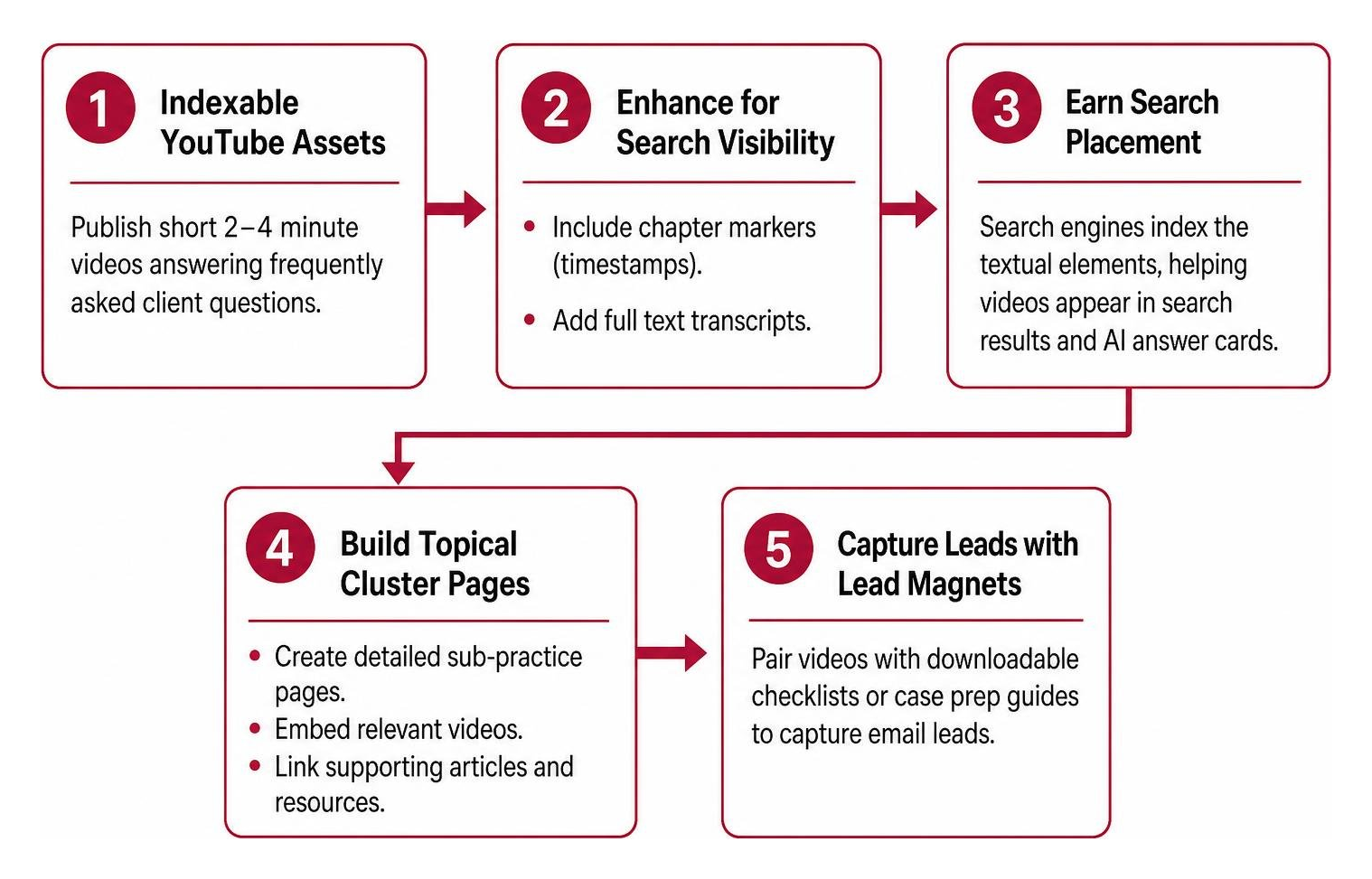
- Indexable YouTube Assets: Publish short 2-to-4 minute videos answering frequently asked client questions (e.g., “What should I do at the scene of an auto accident in Ohio?”).
- Include Chapter Markers & Transcripts: Add detailed timestamps and full text transcripts. Search engines index these textual elements, allowing your videos to appear directly in search results and AI answer cards.
- Lead Magnets: Pair informational videos with downloadable checklists or case prep guides to capture email leads from prospects who are still in the research phase of their legal journey.
Managing Budgets, PPC Traps, and Legal Ethics
A campaign has to make money and stay inside bar rules. Here’s how to do both.
Budget Benchmarks and ROI in Digital Marketing for Attorneys
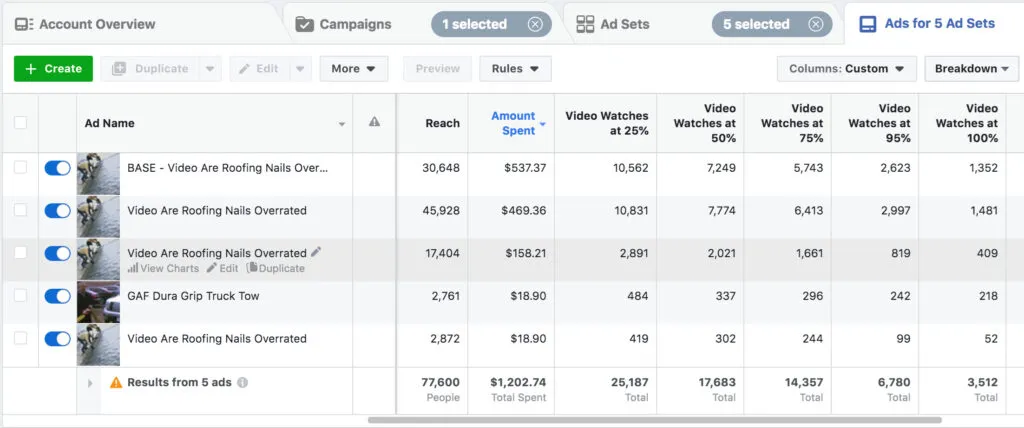
According to law firm marketing statistics for 2026, firms typically allocate between 2% and 12% of gross annual revenue toward marketing. Boutique and growing 5-attorney practices aiming for expansion generally operate in the 7% to 10% range.
An acceptable industry return on investment benchmark is a 5:1 revenue-to-cost ratio, meaning your cost per acquisition (CPA) should represent roughly 20% of your average gross case value.
Paid search costs vary widely across legal niches (DataForSEO top-of-page bid data, August 2026, confirms the spread: about $295 for personal injury lawyer versus $21 to $40 for immigration terms):
- Personal Injury: Average CPCs can range from $75 to $250+ in major metro areas, with cost per signed case averaging $3,000 to $8,000 for standard auto claims.
- Criminal Defense & Family Law: CPCs often sit between $30 and $150, with signed case costs ranging from $800 to $3,000.
- Estate Planning & Immigration: CPCs typically range from $15 to $50, with signed case acquisition costs averaging $200 to $600.
Avoiding Expensive Google Ads Mistakes
Legal keywords are some of the priciest in PPC. Without tight management, unqualified traffic drains the budget fast.
Avoid these costly paid search pitfalls:
- Relying on Unchecked Broad Match Keywords: Using broad match terms without extensive negative lists will waste your budget on irrelevant queries like “free legal advice” or “paralegal salary.” Stick to phrase match and exact match during initial campaign rollout.
- Neglecting Negative Keyword Lists: Load a list of 200+ negative keywords prior to launch to filter out DIY searchers, job applicants, and unrelated practice areas.
- Sending Traffic to the Homepage: Directing a user searching for an emergency DUI attorney to your generic firm homepage forces them to search for contact details. Always send paid traffic to tailored, high-converting landing pages.
- Missing Off-Hours Inquiries: 35% to 40% of legal inquiries happen outside regular business hours. If you run ads late at night or on weekends without 24/7 call answering or live chat, those paid clicks will go unanswered.
Ethical Considerations in Digital Marketing for Attorneys
Every public page, ad, and social post is subject to state bar advertising regulations and ABA Model Rules 7.1 and 7.2. Violations can result in disciplinary action or formal reprimands.
- No False or Misleading Claims: Never promise, predict, or guarantee specific case outcomes.
- Prohibited Specialization Claims: Do not refer to attorneys as “specialists” or “experts” unless formally certified by an accredited state bar program.
- Mandatory Disclaimers: Include clear disclaimers stating that website content represents general educational information, does not constitute legal advice, and does not create an attorney-client relationship.
- Confidentiality in Online Reviews: When responding to negative online reviews, never reveal client information or confirm that the reviewer was a client, which violates attorney-client privilege.
Tracking Pipeline Attribution and Outranking Larger Competitors
You don’t need a billboard budget to win good cases. A 5-attorney firm can beat regional mega-firms with solid tracking and a fast intake process.
Full-Funnel Attribution from Click to Retained Client
Tracking impressions and raw form submissions is insufficient; true marketing performance is measured in signed retainers and collected fees.
Implementing closed-loop attribution requires an integrated technology stack:
- Dynamic Number Insertion (DNI): Tools like CallRail dynamically assign distinct phone numbers to individual marketing channels (SEO, LSAs, Google Ads, local citations) to pinpoint which keyword generated each call.
- CRM Integration: Integrate your call tracking and website forms directly with legal practice management platforms (such as Clio, Filevine, or PracticePanther) or a dedicated intake CRM.
- The 5-Minute Lead Rule: Research shows contacting a new web inquiry within 5 minutes results in a 400% higher conversion rate compared to longer response delays. Because 66% of legal consumers expect a response within a day and many hire the first attorney who answers their call, speed-to-lead is an operational necessity. In one immigration firm CRM we audited in September 2026, 85% of booked consultations never received a human call or text.
Reuters, August 14, 2026 (Why more leads aren’t growing law firms): law firms are losing growth not for lack of leads but because intake and conversion fail to turn the leads they already pay for into clients.
Competing with Big-Budget Law Firms on High-Value Keywords
Large volume practices often spend hundreds of thousands of dollars monthly bidding on broad keywords. Boutique firms can compete effectively by playing a more focused game.
- Target Specific Sub-Practice Niches: Instead of bidding on broad, highly competitive terms like “injury attorney,” focus content and local campaigns on specific niches such as “rideshare accident attorney” or “commercial vehicle accident liability.”
- Use Hyper-Local Long-Tail Keywords: Optimize content for specific municipal jurisdictions and courts where you practice. Explore our curated free law firm resources & tools to access planning frameworks designed to uncover high-intent, low-competition opportunities in your local market.
- Highlight Direct Attorney Access: Emphasize personal attorney-client communication. Many clients prefer working directly with an experienced partner over being routed through junior associates at a massive firm.
Digital Marketing for Attorneys by the Numbers
143
Calls from Google Business Profile in one month for an immigration firm, 560 in five months, $0 ad spend.
Source: Rocket Launch Media client data, 2026
$295 vs $21–$40
Google Ads top-of-page bid for personal injury lawyer versus immigration keywords. Practice area sets the click cost.
Source: DataForSEO, August 2026
45%
of U.S. consumers have asked AI for a local business recommendation, up from 6% a year earlier.
Source: BrightLocal Local Consumer Review Survey, 2026
Frequently Asked Questions About Legal Digital Marketing
What is the most effective marketing channel for a 5-attorney law firm?
For a 5-attorney firm, the most cost-effective starting point is Google Local Services Ads (LSAs) paired with Local Map Pack SEO. LSAs provide immediate trust through the Google Screened badge on a pay-per-lead basis, while a fully optimized Google Business Profile captures local searchers without recurring click costs. Once these channels are stabilized, scaling sub-practice SEO pages and targeted Google Ads provides balanced, compounding client growth.
How much should a small law firm spend on digital marketing per month?
Most small to mid-sized firms invest between $4,000 and $8,000 per month across software, advertising spend, and agency management. This budget is typically allocated with roughly 45% toward organic SEO and content development, 30% toward paid search (Google Ads and LSAs), 10% toward social media or email nurturing, and 15% toward tracking infrastructure and website optimization. The goal is to maintain a minimum 5:1 revenue-to-cost return over a 12-month period.
How do AI Overviews impact attorney search rankings in 2026?
AI Overviews summarize complex legal topics directly at the top of search engine results pages. To appear as a cited source within these AI snapshots, law firms must practice Generative Engine Optimization (GEO). This involves publishing comprehensive, original legal insights with clear structural formatting (schema markup, concise summary answers, and accredited attorney bylines) that AI models can easily reference when answering user queries. Paid placement inside ChatGPT is now available to US firms as well; see our guide to running ChatGPT ads for a law firm.
How much do Google Ads clicks cost for attorneys in 2026?
It depends almost entirely on practice area. DataForSEO top-of-page bid data for August 2026 shows about $295 for personal injury lawyer, $84 for criminal defense, $37 for divorce, and $21 to $40 for immigration keywords. A firm’s real number is cost per signed case, which combines click cost with landing page conversion, intake speed and consultation show rate.
Do Facebook ads work for law firms?
Yes, especially in practice areas where the client has a problem before they know the legal term for it, such as immigration. One New York immigration firm turned $1,663.12 in Meta ad spend into 535 leads at $3.11 each and 174 booked consultations in July and August 2026 (Rocket Launch Media client data). Judge Facebook ads on cost per booked consultation and cost per retained case, never on cost per lead alone.
How fast should a law firm respond to a new lead?
Within five minutes. Contacting a web inquiry within five minutes produces roughly 400% higher conversion than slower follow-up, and many legal clients hire the first attorney who answers. Automate the first text and booking link so a human call follows quickly; in one immigration firm audit, 85% of booked consultations never received a human call or text, which wasted most of the ad spend that produced them.
Sources
Rocket Launch Media client data and intake audit, 2026 (SEO case study, Meta ads case study) · BrightLocal Local Consumer Review Survey, 2026 · Reuters, Why more leads aren’t growing law firms, August 2026 · Ahrefs study of 75,000 brands, 2026 · Revenue Memo law firm marketing statistics, 2026 · DataForSEO Google Ads bid data, August 2026.
Building Your Law Practice Growth Engine
It comes down to three things working together: strong local search visibility, targeted paid ads, and fast intake that turns inquiries into signed clients. Line those up and you get a predictable client pipeline.
Ready for a trackable growth plan that turns search traffic into signed retainers, explore our immigration law firm marketing services at Rocket Launch Media to see how we build measurable client acquisition systems for immigration law firms.